
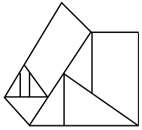
How many triangles are there in the given figure?
- (a)6
- (b)8
- (c)4
- (d)5
Answer
Why
Correct — B. No triangle crosses the long slant running from the right-hand box down to the left end of the base, so count each side of it and add.
Left of the slant — 4.
A horizontal joins the tilted square's left and right corners: one triangle above, one below — 2.
Two short verticals drop from the upper triangle's sloping sides to that horizontal, cutting off a right triangle at each end — 2.
Right of the slant — 4.
The big triangle closed by the two long slants and the base — 1.
A tall vertical from its apex to the base splits that one in two — 2.
The short vertical hanging from the band's corner closes one more against the slants — 1.
4 + 4 = 8 → option (b).
Why the others are wrong
- (a)6 — 6 is the number of smallest triangles only: the two cut off by the short verticals, the one below the horizontal, the two halves of the large right-hand triangle, and the one between the long slants. It misses the two whole triangles those pieces sit inside.
- (c)4 — 4 is the count you reach by ignoring the two short verticals on the left and the tall vertical on the right. Each vertical builds more: the two short ones add one triangle each, and the tall vertical adds two.
- (d)5 — 5 falls three short. The right-hand cluster alone already holds four — the large triangle, its two halves either side of the tall vertical, and the one between the long slants — before the left-hand cluster is counted at all.
Concept
Counting triangles reliably means counting by construction, not by eye. Break the drawing into clusters that share no lines, count each cluster completely, then add the clusters.
Inside a cluster, count in layers: first the smallest enclosed triangles, then every triangle formed by combining or spanning them.
Two line types do the work. A line from a vertex to the opposite side turns one triangle into three — the two parts and the original. A line joining one side to another cuts off one new triangle and leaves the original intact.
The tall vertical runs from the apex of the large right-hand triangle down to its base, so it is the first type and yields three triangles from one.
The two short verticals run from a sloping side down to the horizontal, so each yields only one extra.
Key facts
- The figure holds 8 triangles: four in the left cluster and four in the right.
- A line from a vertex to the opposite side turns one triangle into three.
- A line joining two sides of a triangle cuts off one extra triangle and leaves the original whole.
Study next
Common traps
- Counting only the smallest enclosed regions, which stops the total at 6.
- Missing the triangle below the short horizontal line, which reads as part of the shape above it.
- Treating the tall vertical as if it merely split the base, when it creates two further triangles.
SSC's figure-counting items reward a written method over a glance: split the drawing into clusters that share no lines, count each in layers, then add.
This shift runs picture reasoning at Q.6 and Q.10 as well (9 Sep 2024, 16:00).
Related PYQs
No directly related past PYQ was found.