
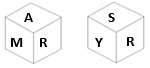
Six letters A, M, R, S, Y and Q are written on different faces of a dice. Two positions of this dice are shown in the figures below. Find the letter on the face opposite to S.
- (a)Y
- (b)M
- (c)Q
- (d)A
Answer
Why
Correct — D. Two views of one cube, with R on the right-hand face in both.
View 1: A on top, M on the left, R on the right.
View 2: S on top, Y on the left, R on the right.
Because R has not moved, the cube has only been turned about the axis through R and the face behind it. A quarter-turn about that axis would leave either A or M still in view; the second view shows neither, so it is a half-turn.
Rule: a half-turn about a fixed face sends the top face to the bottom.
A was on top before the turn and S is on top after it, so A and S are the opposite pair — option (d).
Why the others are wrong
- (a)Y — Y is drawn beside S in the second view, on the face next to it. Two faces you can see together are adjacent, so Y cannot lie opposite S.
- (b)M — M is on the left in view 1, Y on the left in view 2. The half-turn about R swaps top with bottom and left with the hidden back face, so M is opposite Y, not S.
- (c)Q — Q appears in neither view. The four letters drawn beside R — A, M, S and Y — are all adjacent to R, which makes Q the face opposite R, a different pair from the one asked for.
Concept
When one face keeps the same position across two views, the die has been rotated about that face's axis, and only four turns are possible: a quarter-turn either way, a half-turn, or no turn at all.
Rule out the quarter-turns first. A quarter-turn keeps one of the other visible faces in view, so if none of the first view's letters reappears, the turn was a half-turn.
A half-turn about a fixed face swaps the two remaining pairs straight across: top with bottom, and the visible left face with the hidden one behind it.
The common face settles its own pair for free. A, M, S and Y are all drawn beside R, so the sixth letter Q lies opposite R. That is not what the question asks, which is exactly why Q is offered as option (c).
Key facts
- A face that holds its position across two views has not moved, so the die was turned about that face's axis.
- A quarter-turn about a fixed face keeps one of the other visible faces in view.
- A half-turn about a fixed face swaps top with bottom, and the visible left face with the hidden face behind it.
Study next
Common traps
- Choosing Q because it is the letter you never see, when Q is opposite R and the question is about S.
- Reading the two drawings as two different dice.
- Assuming a quarter-turn without checking that it would have left A or M in view.
This section also sets a dice item at Q.3 (9 Sep 2024, 16:00), which takes the simpler route: four distinct neighbours of the common face name the fifth by elimination.
This one needs the turn, because the face asked about is not the common one.
Related PYQs
No directly related past PYQ was found.