
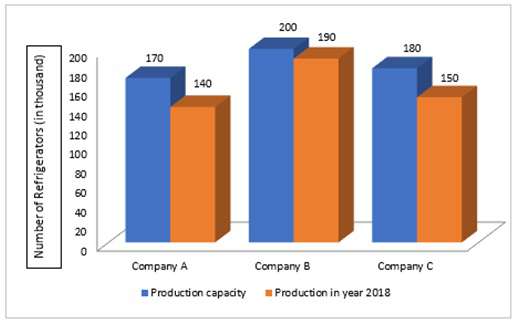
Study the given graph and answer the question that follows. The graph shows the production of refrigerators by three companies in 2018. The refrigerators produced by company C form what percentage of the total production?
- (a)34.35%
- (b)31.25%
- (c)32.56%
- (d)30.25%
Answer
Why
Correct — B. The graph carries two bars per company: a blue capacity bar and an orange 2018-production bar. The question asks about production, so only the orange bars count.
Production in 2018 (thousands): A = 140, B = 190, C = 150
Total production = 140 + 190 + 150 = 480
C's share = 150⁄480 = 5⁄16
= 0.3125 = 31.25% → option (b).
Why the others are wrong
- (a)34.35% — Too high. 34.35% of the 480-thousand total would be 164.9 thousand refrigerators, but company C's 2018 bar is labelled 150.
- (c)32.56% — The blue bars are capacity, not production. Working from those gives 180⁄550 = 32.7%, which sits beside this option — but the question names production in 2018, where C is 150 of 480.
- (d)30.25% — Too low. 30.25% of 480 thousand is 145.2 thousand, and C's 2018 bar reads 150. The exact share is 5⁄16, or 31.25%.
Concept
The figure is a grouped bar graph with three companies (A, B, C) and two bars each, measured in thousands of refrigerators.
The blue bars are production capacity — 170, 200 and 180. The orange bars are production in year 2018 — 140, 190 and 150. Every bar is value-labelled, so nothing has to be measured against the axis.
A "what percentage of the total" question needs the part and the total drawn from the same series. Taking a part from one series and a total from the other is the standard way this item is lost.
Here both come from the orange series: 150 out of 480.
The bars are drawn in a 3-D style and the tops are slanted, but each carries a printed number, so the styling is decoration — read the labels, not the heights.
Key facts
- Company C produced 150 thousand refrigerators in 2018 against a capacity of 180 thousand.
- The three companies' 2018 production totals 140 + 190 + 150 = 480 thousand.
- 150 of 480 is exactly 5⁄16, which is 31.25%.
- The same computation on the capacity bars gives 180 of 550, about 32.7% — a different question from the one asked.
Study next
Common traps
- Using the capacity bars because they are taller and named first in the legend.
- Adding all six bars to build the total.
- Answering C's share of its own capacity, 150 of 180 = 83.3%, instead of its share of total production.
The reading step and the arithmetic step are always kept separate in this family. This shift also sets a printer table at Quant Q.2 and a T-shirt production table at Quant Q.11.
Related PYQs
No directly related past PYQ was found.