
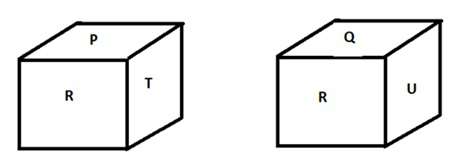
Six letters P, Q, R, S, T and U are written on different faces of a dice. Two positions of this dice are shown in the figure below. Find the letter on the face opposite to R.
- (a)U
- (b)Q
- (c)S
- (d)T
Answer
Why
Correct — C. The figure shows one box drawn twice.
First view: P on top, R on the front, T on the right.
Second view: Q on top, R on the front, U on the right.
Rule: two faces drawn in the same view share an edge, so neither can be opposite the other.
R is drawn with P and T in the first view and with Q and U in the second, so all four of P, Q, T and U touch R. A face touches exactly four others, so those four are the whole ring around R.
One letter is left for the hidden face behind R: S, which is option (c).
Why the others are wrong
- (a)U — U shares the second drawing with R, sitting on the right face while R faces you. Two faces you can see at once meet along an edge, so U is adjacent to R, not opposite it.
- (b)Q — Q sits on top of the box in the second drawing while R faces you, which makes Q one of R's four neighbours. The face opposite R is the one that appears in neither drawing.
- (d)T — T is the right-hand face in the first drawing, directly beside the R that faces you. It is visible with R, so it is adjacent to R.
Concept
A die has six faces in three opposite pairs. One short rule settles most SSC dice questions: any two faces visible in the same drawing are adjacent, never opposite.
So collect every letter that appears alongside your target face across all the views you are given. Each of them is adjacent to it.
A face touches exactly four others. Once four different letters have appeared beside your letter, the ring is complete and the sixth letter must be the face opposite.
R keeps the same position in both drawings, so you never have to imagine the box turning. Between them the two views simply reveal four of R's five neighbours by name.
Key facts
- A die has 6 faces forming 3 opposite pairs, and each face is adjacent to exactly 4 others.
- Two faces seen in the same view are always adjacent.
- If four distinct letters appear beside one face across the views, the sixth letter is its opposite.
Study next
Common traps
- Reading the two drawings as two different dice, when the stem says two positions of one die.
- Hunting for a rotation when a repeated face has already named the neighbours.
- Choosing a letter you can see beside R, which by definition cannot lie opposite it.
This Reasoning section also sets a dice item at Q.5 (9 Sep 2024, 16:00).
The difference is what the question asks for. Here the common face is the one you are asked about, so elimination finishes the job; at Q.5 it is not, and the die has to be turned.
Related PYQs
No directly related past PYQ was found.