
Identify the figure given in the options which when put in place of the question mark (?) will logically complete the series?
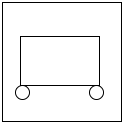
- (a)
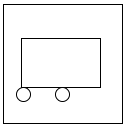
- (b)
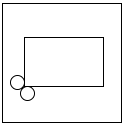
- (c)
- (d)
Answer
Why
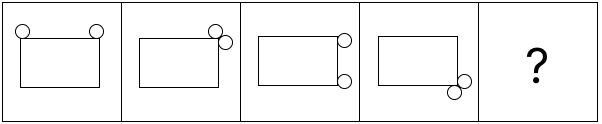
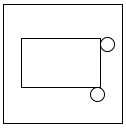
Correct — A. Rule: both circles travel clockwise round the rectangle, and in figures 1, 3 and 5 they sit at the two ends of one complete side.
Figure 1: the circles straddle the top side, one at each end.
Figure 2: the pair is bunched at the top-right corner, mid-turn.
Figure 3: the circles straddle the right side, one at each end.
Figure 4: the pair is bunched at the bottom-right corner, mid-turn.
Clockwise from the right side comes the bottom side. So figure 5 shows one circle at the bottom-left corner and one at the bottom-right corner, both hanging below the bottom edge.
That is option (a).
Why the others are wrong
- (b)Its second circle sits roughly halfway along the bottom edge instead of at the bottom-right corner. In the odd-numbered figures the two circles always mark the two ends of a side.
- (c)It shows the bunched, mid-turn arrangement at the bottom-left corner. That is what figure 6 would look like, one step past the figure being asked for.
- (d)Both its circles hug the right-hand corners, which is figure 3 over again. The pair had already left that side by figure 4.
Concept
In a moving-element figure series the frame stays put and one or two marks travel round it. Fix the direction of travel first — clockwise here — and the rest is counting.
The tell in this series is its rhythm. The odd-numbered figures spread the circles to the two ends of a side, and the even-numbered figures cluster them around the corner they are rounding.
So nothing needs measuring. Name the side the odd figures are using, advance it one place clockwise, and read the options for that arrangement.
The rectangle drifts slightly from box to box, which is decoration. Only the circles' positions relative to the corners carry the pattern.
Key facts
- The circles move clockwise: the top side, then the right side, then the bottom side.
- Figures 1 and 3 place the two circles at the two ends of a single side.
- Figures 2 and 4 bunch the two circles around the corner being turned.
Study next
Common traps
- Choosing the mid-turn arrangement, which belongs to the figure after the one asked for.
- Accepting an option in which only one of the two circles has reached a corner.
SSC runs several non-verbal items inside one Reasoning block. This paper also carries a symbol-shift series at 09 Sep 2024, 16:00, Reasoning Q.22 and a pattern-completion figure at Q.10.
Related PYQs
No directly related past PYQ was found.