
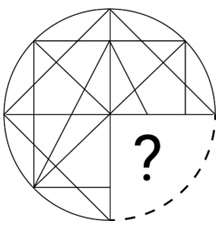
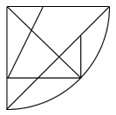
Select the option that will replace the question mark (?) in the figure given below to complete the pattern.
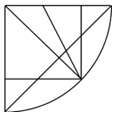
- (a)
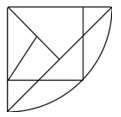
- (b)
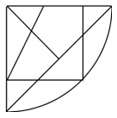
- (c)
- (d)
Answer
Why
Correct — A. The two diameters cut the circle into four quarters, and the bottom-right quarter is missing.
Rule: every line that reaches a cut edge from the intact side must continue across it.
Along the top cut edge, two lines arrive from the quarter above — a slanting chord about a third of the way out from the centre, and the inner square's right side, a vertical about seven-tenths of the way out.
Along the left cut edge one line arrives — the inner square's bottom side, a horizontal about seven-tenths of the way down.
It must also carry the 45° diagonal from the centre to the square's corner on the rim, and the chord joining the far ends of the two cut edges.
Option (a) is the piece that draws all of them, with its slanting chord running down-right into the square's corner.
Why the others are wrong
- (b)Option (b)'s top edge is bare between the centre and the square's side. The slanting chord coming down from the quarter above would stop dead at the cut; its own sloping line starts from the left edge instead.
- (c)Option (c) starts a slanting line at the right point on the top edge but runs it down-left, towards the vertical radius. Every other line in this quarter runs into the square's corner on the rim, and this one heads away from it.
- (d)Option (d)'s vertical never reaches its top edge — it begins about a third of the way down. The square's right side arrives at the cut from the quarter above and would be left hanging.
Concept
Pattern-completion on a circle is decided at the cut, not by the picture as a whole. The missing piece has two straight edges, and every line touching those edges from the intact side has to carry on into it.
So work the edges first. List the points where lines meet the two radii, note whether each arrival is a vertical, a horizontal or a slant, and note which way each slant leans.
Then check the interior: a diagonal through the centre, and any chord joining two rim points, must continue as straight lines rather than stopping inside the piece.
The figure is built from a circle, an inscribed square, a tilted square through the four rim points of the diameters, and a few chords across them.
Knowing the construction is optional — matching the cut edges settles the answer on its own.
Key facts
- A line meeting a cut edge from one side must continue on the other side.
- A slant's lean matters as much as its crossing point, because two options can cross at the same place and lean opposite ways.
- In the correct piece, four lines converge on the inscribed square's corner where it touches the rim.
Study next
Common traps
- Matching only the square outline, which all four options draw in the same place.
- Ignoring which way a slanting line leans.
- Assuming the quarter is a rotated copy of another quarter — this figure repeats left to right, not by rotation.
Picture reasoning also runs at Reasoning Q.6 (an embedded figure) and at Q.22 and Q.24 (figure series), all 9 Sep 2024, 16:00.
Each is settled by naming two or three decisive features rather than comparing whole pictures.
Related PYQs
No directly related past PYQ was found.