
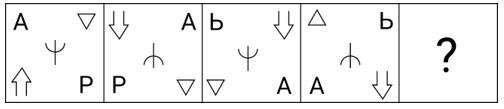
Select the figure from among the given options that can replace the question mark (?) and logically complete the series.
- (a)
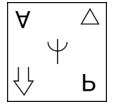
- (b)
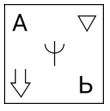
- (c)
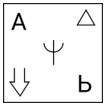
- (d)
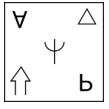
Answer
Why
Correct — A. Rule: each corner symbol steps one place clockwise, and whichever symbol arrives at the top-left cell turns upside down and stays so.
Follow the A: top-left, top-right, bottom-right, bottom-left. In frame five it returns to the top-left, so it arrives inverted.
The same trigger inverted the arrow in frame two, flipped the P in three and turned the triangle point-up in four.
The centre trident alternates upright and inverted, so frame five is upright.
Option (a) alone has all four: inverted A, upward triangle, downward arrow, upright trident.
Why the others are wrong
- (b)Two faults. The A is upright although it has just landed in the top-left cell, and the triangle points down although it turned point-up in frame four and has stayed that way.
- (c)Every position is right and the triangle is right, but the A is still upright. The top-left cell is exactly where the inversion happens, and this is the frame the A reaches it.
- (d)The A is correctly inverted, but the bottom-left arrow points up. That arrow inverted in frame two, when it passed through the top-left cell, and has pointed down ever since.
Concept
Read a two-rule figural series one element at a time, never a frame at a time.
Fix on a single symbol, write down its cell in all four given frames, and the movement rule falls out — a clockwise step here.
Then treat orientation as a separate question: which symbols changed, and where. When every change happens in the same cell, the cell is the trigger, not the frame number.
The centre symbol usually runs its own rule; here it simply alternates upright and inverted.
The positions alone look like a 90° rotation of the whole frame, but they are not: under a real rotation every symbol would tilt with it, and here the letters and the trident keep their bearing. The symbols move between cells; the frame does not turn.
Key facts
- The corner cycle is clockwise: top-left, top-right, bottom-right, bottom-left, back to top-left.
- A symbol inverts on arriving at the top-left cell and keeps that orientation in every later frame.
- The central trident runs its own rule, alternating upright and inverted each frame.
Study next
Common traps
- Deciding the whole frame rotates: the cells fit a 90° turn, but the symbols stay upright, so it does not
- Assuming the inversions alternate, when each symbol inverts once and then stays inverted
- Choosing on position alone, which settles nothing here — all four options put the same symbol in the same cell
SSC's four-frame figural series give three transitions, enough to test a rule twice: confirm it on frame 1 to 2 and again on frame 3 to 4 before looking at the options. The same shift runs a single-object rotation series at Reasoning Q.13.
Related PYQs
No directly related past PYQ was found.