
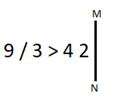
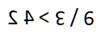
Select the correct mirror image of the given figure when the mirror is placed at MN as shown below.
- (a)
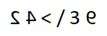
- (b)
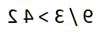
- (c)
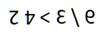
- (d)
Answer
Why
Correct — B. Rule: reverse the order, then flip every character left to right.
9 / 3 > 4 2 read backwards is 2, 4, >, 3, /, 9.
Now invert each one: the 2 and the 4 become their backward forms, > becomes <, the 3 becomes a backward 3, the forward slash becomes a backslash, and the 9 becomes a backward 9.
Option (b) is the only one that does all six. Mirror it back and you recover 9 / 3 > 4 2 exactly.
Why the others are wrong
- (a)It leaves the slash leaning the same way and prints an ordinary 3. Both characters are asymmetric and both must flip; everything else in the option is right.
- (c)The <, the backward 3, the backslash and the backward 9 are all right, but the 2 and the 4 are turned upside down rather than flipped side to side.
- (d)It keeps the slash leaning forward and shows the 9 as a 6. A 6 is the 9 turned through 180°, not a left-to-right flip.
Concept
Under a vertical mirror the character order reverses and each character is laterally inverted.
With digits the trap is symmetry about the wrong axis. A character survives a vertical mirror unchanged only if it is symmetric about the vertical axis — 0 and 8 are. A 3 feels symmetric because it is — about the horizontal axis — so it does change here.
Operators change too: > reflects to <, and / reflects to \.
Check a candidate by mirroring it back; the right option returns the original string.
Five of the six characters here are asymmetric, which is why the four options can differ on several counts at once and still all look plausible at a glance.
Key facts
- A vertical mirror reverses character order and flips each character left to right.
- A digit survives a vertical mirror unchanged only if it is symmetric about the vertical axis, as 0 and 8 are.
- '>' reflects to '<' and '/' reflects to '\'.
- Mirroring the correct option a second time returns the original string.
Study next
Common traps
- Reversing the order but leaving the slash and the inequality sign untouched
- Treating a 180° turn as a mirror, so the 9 comes out as 6
- Assuming the 3 is symmetric because it is symmetric about the other axis
SSC mixes digits with operators — slashes, inequality signs, brackets — because candidates check the digits and skim the symbols. The same shift runs the letter version immediately before, at Reasoning Q.2.
Related PYQs
No directly related past PYQ was found.