
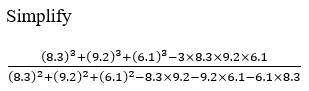
Simplify [(8.3)³ + (9.2)³ + (6.1)³ − 3 × 8.3 × 9.2 × 6.1] ⁄ [(8.3)² + (9.2)² + (6.1)² − 8.3 × 9.2 − 9.2 × 6.1 − 6.1 × 8.3]
- (a)30.2
- (b)25.5
- (c)28.7
- (d)23.6
Answer
Why
Correct — D. The printed fraction is one identity in disguise:
a³ + b³ + c³ − 3abc = (a + b + c)(a² + b² + c² − ab − bc − ca), with a = 8.3, b = 9.2, c = 6.1.
The numerator is the whole left-hand side. The denominator is the second bracket, verbatim. So the bracket cancels and only the first factor survives:
value = a + b + c
= 8.3 + 9.2 + 6.1
= 23.6 → option (d)
Do not cube the decimals. The expression was built to cancel.
Why the others are wrong
- (a)30.2 — The fraction can only equal the plain sum of the three printed numbers. For 30.2 they would have to average about 10.07 each — more than the largest of them, 9.2.
- (b)25.5 — The closest decoy, and the one that catches a hurried addition. Add again: 8.3 + 9.2 = 17.5, then 17.5 + 6.1 = 23.6, not 25.5.
- (c)28.7 — 28.7 is 23.6 + 5.1. Since the value is fixed at the sum of 8.3, 9.2 and 6.1, no regrouping of those three numbers reaches it.
Concept
a³ + b³ + c³ − 3abc factorises as (a + b + c)(a² + b² + c² − ab − bc − ca), and SSC deploys it almost always in this fraction shape — so the answer is nothing but a + b + c.
Learn the fingerprint rather than the derivation: three cubes, a −3abc term, and a denominator carrying three squares minus the three cross products, every cross product negative.
The brute-force arithmetic confirms it: numerator 180.068, denominator 7.63, and 180.068 ÷ 7.63 = 23.6.
The decimals are deliberate. They make cubing look forbidding, which is the whole point of the item.
It takes about twenty seconds by identity and several error-prone minutes by brute force. Recognition, not arithmetic, is what is being marked.
Key facts
- a³ + b³ + c³ − 3abc = (a + b + c)(a² + b² + c² − ab − bc − ca).
- The second bracket also equals ½[(a − b)² + (b − c)² + (c − a)²], so it vanishes only when a = b = c.
- If a + b + c = 0 the whole left side is zero, giving the much-used corollary a³ + b³ + c³ = 3abc.
Study next
Common traps
- Actually cubing 8.3, 9.2 and 6.1 — correct but far too slow, and a decimal slip is close to certain.
- Not checking the denominator's signs: the identity needs a minus on all three cross products.
- Doing the recognition right and then adding the three decimals wrong at the last step.
SSC prints this as a 'Simplify' item with an intimidating decimal fraction, the numerator and denominator laid out exactly as the two halves of the identity. A common variant states the numerator in numbers and the denominator in symbols, which is the same one-line cancellation.
Related PYQs
No directly related past PYQ was found.