
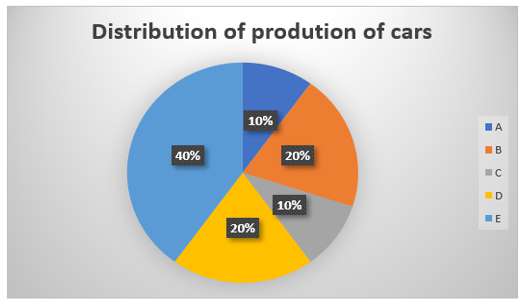
The given chart shows the production of different types of cars in the year 2021. Study the given chart and answer the question that follows. If the total production in the year 2021 was 2,00,00,000, then what will be the central angle of the sector representing the production of type D cars in 2021?
- (a)50°
- (b)42°
- (c)36°
- (d)72°
Answer
Why
Correct — D. The chart gives shares, not counts: A 10%, B 20%, C 10%, D 20%, E 40%.
A full circle is 360°, so one percentage point is 3.6°:
central angle of D = 20 × 3.6°
= 72° → option (d)
Or read it as a fraction: 20% is one-fifth of the pie, and 360° ÷ 5 = 72°.
The 2,00,00,000 total is a decoy — it cancels out of production ÷ total, so it moves no sector's angle.
Why the others are wrong
- (a)50° — 50° is 50 ÷ 3.6 ≈ 13.9% of production, and no sector on this chart holds that share. A number printed on a pie chart is a percentage; multiply it by 3.6 before calling it degrees.
- (b)42° — 42° corresponds to 42 ÷ 3.6 ≈ 11.7%, again a share no sector on this chart has. Check which slice you are reading against the legend before converting.
- (c)36° — 36° is a real angle on this chart, but it belongs to the 10% sectors, A and C. It is also what 20% gives if you scale by 1.8 instead of 3.6 — spreading the pie over 180°.
Concept
A pie chart converts shares into angles through one constant: the full circle is 360°, so 1% = 3.6° and a fraction f becomes 360f degrees.
Nothing else about the data matters for an angle question. Double every production figure and every sector angle stays exactly where it was.
That is why a grand total is supplied so often — it is essential for a 'how many cars' item and useless for a 'what angle' item, and SSC asks the same chart both ways.
The five shares in the chart are A 10%, B 20%, C 10%, D 20% and E 40%, which sum to 100%.
B carries the same 20% as D, so B's sector is also 72° — an angle question on this chart cannot distinguish them.
Key facts
- Central angle = share × 360°, so 1% = 3.6° and a quarter of the pie is 90°.
- Type D is 20% of 2021 production, which makes its sector 72°.
- 20% of 2,00,00,000 is 40,00,000 cars — the figure an angle question does not need.
- A sector's angle depends only on the proportions, never on the absolute total.
Study next
Common traps
- Using 180° instead of 360°, which halves every angle.
- Reading a sector's printed percentage straight off as a number of degrees.
- Computing the absolute production first when the question only wants an angle.
SSC hangs three or four questions on one pie chart: an angle conversion, an absolute value that does use the supplied total, and a ratio between two sectors.
Quant Q.4 of this shift (09 Sep 2024, 12:30) is the other kind — a pie chart of expenditure where the ₹54,000 income must be used. Decide first whether the total is relevant to the question in front of you.
Related PYQs
No directly related past PYQ was found.