
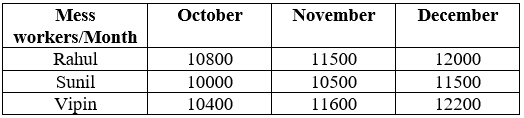
The monthly wages (in ₹) of three mess workers, Rahul, Sunil and Vipin, of a boy’s hostel for three months are given in the following table. Study the table carefully and answer the question given below. In November, the wages of Sunil is what percentage of the wages of Rahul? (Correct up to two decimal places.)
- (a)91.30%
- (b)90.23%
- (c)89.30%
- (d)88.23%
Answer
Why
Correct — A. Read the November column only: Rahul ₹11,500, Sunil ₹10,500.
"Sunil is what percentage of Rahul" puts Rahul in the denominator.
10,500 ÷ 11,500 = 21⁄23
21 ÷ 23 = 0.913043…
× 100 = 91.3043…%
Two decimal places = 91.30% → option (a).
Why the others are wrong
- (b)90.23% — 90.23% of ₹11,500 is ₹10,376.45, not Sunil's ₹10,500. It survives a rough "about 90%" estimate, which is exactly why a two-decimal item cannot be eyeballed.
- (c)89.30% — 89.30% of ₹11,500 is ₹10,269.50 — over ₹230 short of Sunil's November wage. The matching decimal tail .30 is all it shares with the answer.
- (d)88.23% — 88.23% of ₹11,500 is ₹10,146.45. No pair of November figures in the table produces it; it is the furthest of the four decoys from 21⁄23.
Concept
"A is what percentage of B" = (A ÷ B) × 100. The quantity after "of" is the base, and the base goes in the denominator.
Table items add a second discipline: fix the row and the column before you touch the arithmetic. Three names recur across three months, so a wrong cell still yields a plausible-looking answer.
When the stem says "correct up to two decimal places", carry the division to four places and round once, at the end.
All four options lie between 88% and 92%, so nothing can be eliminated by eye. The item tests careful division, not estimation.
Key facts
- In the November column of the table, Rahul's wage is ₹11,500 and Sunil's is ₹10,500.
- "A as a percentage of B" is (A ÷ B) × 100, with B — the quantity after "of" — as the base.
- 10,500⁄11,500 reduces to 21⁄23, and 21 ÷ 23 = 0.913043…
Study next
Common traps
- Reversing the base — Rahul as a percentage of Sunil gives 109.52%
- Right row, wrong column: October gives 92.59% and December 95.83%
- Rounding to 91.3% early, then picking whichever option looks nearest
SSC hangs several questions on one small table in a shift — a percentage-of, a ratio, an average — with only the row, the column and the operation changing. Data interpretation returns twice more in this same shift: a pie chart at Quant Q.4 and a bar graph at Quant Q.20 (09 Sep 2024, 12:30).
Related PYQs
No directly related past PYQ was found.