
How many triangles are there in the given figure?
- (a)4
- (b)6
- (c)3
- (d)5
Answer
Why
Correct — A. Rule: a triangle needs three straight sides — a region closed partly by a curve does not count.
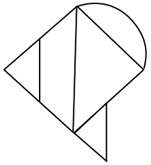
The figure is a square standing on one corner. The line joining its top and bottom corners splits it into two triangles.
A short vertical stroke cuts a third, small triangle off the left corner.
Outside the square, below the lower-right side, a vertical stroke and a slanting one close a fourth.
The region on the upper right is capped by an arc, so it is a circular segment. Total = 4.
Why the others are wrong
- (b)6 — Six is an over-count. Only four regions here have three straight sides. Reaching six means counting the arc-capped region and the four-sided panel between the short vertical stroke and the long one.
- (c)3 — Three is one short. It is what you get from the two halves of the square plus the small corner triangle, having missed the fourth one drawn outside the square, below the lower-right side.
- (d)5 — Five comes from counting the arc-capped region on the upper right. It has one straight side — the line from the top corner to the right corner — and one curved one, so it is a circular segment, not a triangle.
Concept
Counting figures is an exhaustiveness problem, not a geometry problem.
Work in a fixed order: list every straight line in the figure, count the smallest triangles first, then the ones built by joining two or more regions.
Two filters do most of the work here. A boundary that curves disqualifies a region outright. And two parallel lines can never be two sides of one triangle, so the three vertical strokes in this figure never pair with each other.
The arc is drawn to bait a fifth count; the small triangle outside the square is drawn to be forgotten.
One region you must reject, one you must not miss — and the answer moves by one either way.
Key facts
- A triangle needs three straight sides.
- A region closed partly by an arc is a circular segment, not a triangle.
- Two parallel lines cannot be two sides of the same triangle.
- A diagonal of a quadrilateral divides it into exactly two triangles.
Study next
Common traps
- Counting the arc-capped region because it looks like a triangle with a bulge
- Stopping at the obvious halves and missing the triangle drawn outside the square
- Naming the same triangle twice through two different sets of vertices
SSC prints a small composite figure and asks 'How many triangles are there in the given figure?' The difficulty is bookkeeping, not geometry. Paper-folding at Reasoning Q.19 and Q.20 rewards the same element-by-element reading.
Related PYQs
No directly related past PYQ was found.