
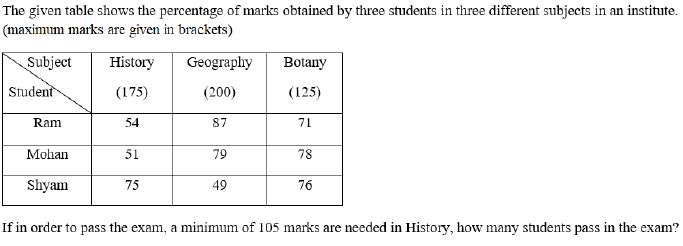
The given table shows the percentage of marks obtained by three students in three different subjects in an institute. (maximum marks are given in brackets) Subject → History (175) | Geography (200) | Botany (125) Ram — 54 | 87 | 71 Mohan — 51 | 79 | 78 Shyam — 75 | 49 | 76 If in order to pass the exam, a minimum of 105 marks are needed in History, how many students pass in the exam?
- (a)2
- (b)3
- (c)1
- (d)0
Answer
Why
Correct — C. The table gives percentages, while the pass mark is given in marks — convert one to the other before comparing anything.
History is out of 175.
Pass mark 105 ⁄ 175 = 0.6 = 60%.
Now read the History column against 60%:
Ram 54% — below
Mohan 51% — below
Shyam 75% — above
Only Shyam clears the bar, so 1 student passes — option (c).
Why the others are wrong
- (a)2 — 2 lets Ram through, but 54% of 175 is 94.5 marks, short of the 105 needed. Only Shyam is above the line.
- (b)3 — 3 passes everyone, yet Mohan's 51% of 175 is 89.25 marks and Ram's 54% is 94.5 — both under 105.
- (d)0 — 0 would need Shyam below the line too, but his 75% of 175 is 131.25 marks, comfortably past 105.
Concept
A table DI set traps the unit, not the arithmetic. Every cell here is a percentage, while 105 is an absolute score.
Two routes settle it, and the second is faster: convert each percentage into marks (54% of 175 = 94.5), or convert the pass mark into a percentage once (105 ⁄ 175 = 60%) and then simply read the column.
Geography and Botany appear in the table but this question never touches them.
The maximum marks sit in brackets in the column headers — History (175), Geography (200), Botany (125) — so a raw number in one column is not comparable with a raw number in another.
Key facts
- The table records percentage scores, not marks, with each subject's maximum in brackets.
- The History paper is out of 175, so a 105-mark pass line is exactly 60%.
- Only Shyam, at 75% in History, is above that 60% line.
Study next
Common traps
- Comparing 105 directly against the numbers in the table, which are percentages
- Assuming History is out of 100 rather than the bracketed 175
One table serves several questions, each shifting the subject or the threshold, so the conversion is done once and reused. This shift also sets a table at Quant Q.16, on candidates appeared and present, and a five-subject marks table at Quant Q.8.
Related PYQs
No directly related past PYQ was found.