
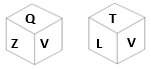
Six letters Q, Z, V, T, L and A are written on different faces of a dice. Two positions of this dice are shown in the figures below. Find the letter on the face opposite to Q.
- (a)Z
- (b)T
- (c)V
- (d)A
Answer
Why
Correct — B. V is common to both views and sits in the same slot — front-right — in each, so the die has only been turned about the V axis.
View 1: top Q, front-left Z, front-right V.
View 2: top T, front-left L, front-right V.
A quarter turn about V would carry Q into the front-left slot, or Z up into the top slot. Neither letter reappears, so it is not a quarter turn.
That leaves a half turn about V, which sends the top face to the bottom and brings the bottom face up.
The letter now on top, T, is therefore the face that was hidden beneath Q → option (b)
Why the others are wrong
- (a)Z — Z shares an edge with Q in the first view — you can see both on the die at once. Adjacent faces are never opposite faces.
- (c)V — V is visible beside Q in view 1, so V and Q are adjacent. V is in fact opposite A, the only letter that appears in neither view.
- (d)A — A is opposite V, not Q. Four letters are seen next to V across the two views — Q, Z, T and L — so the unseen sixth face, A, takes the slot facing V.
Concept
Two views of one die, with a common letter in the same position, is the friendliest form of this question.
The common face tells you the axis the die was turned about. If the other visible letters carry over from one view to the next, the turn was a quarter turn; if none of them do, it was a half turn.
After a half turn about the common face, the remaining visible letters pair off with their opposites: top with top, front-left with front-left.
Read the figure carefully before applying any rule. Here view 1 shows Q on the top face with Z and V below it, and view 2 shows T on the top face with L and V below it — the same front-right position for V in both.
Key facts
- The two views give: Q with Z and V, then T with L and V.
- Q is opposite T, and Z is opposite L, by the half-turn pairing.
- A appears in neither view, so A is the face opposite V.
- A cube has three pairs of opposite faces, and a face seen alongside another can never be its opposite.
Study next
Common traps
- Assuming the common face V must be opposite one of the letters you can see
- Reading the picture as two different dice instead of one die turned
- Pairing Q with L rather than T by matching the wrong slots
This shift asks the dice question again at Reasoning Q.18 (09 Sep 2024, 09:00), where the faces carry the numbers 21 to 26 and three positions are shown.
Related PYQs
No directly related past PYQ was found.