
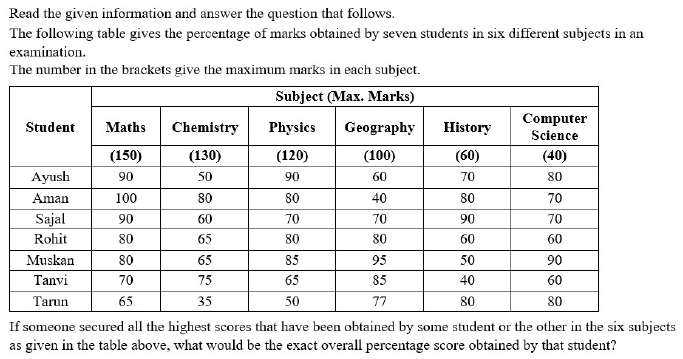
Read the given information and answer the question that follows. The following table gives the percentage of marks obtained by seven students in six different subjects in an examination. The number in the brackets give the maximum marks in each subject. Subject (Max. Marks) → Maths (150) | Chemistry (130) | Physics (120) | Geography (100) | History (60) | Computer Science (40) Ayush — 90 | 50 | 90 | 60 | 70 | 80 Aman — 100 | 80 | 80 | 40 | 80 | 70 Sajal — 90 | 60 | 70 | 70 | 90 | 70 Rohit — 80 | 65 | 80 | 80 | 60 | 60 Muskan — 80 | 65 | 85 | 95 | 50 | 90 Tanvi — 70 | 75 | 65 | 85 | 40 | 60 Tarun — 65 | 35 | 50 | 77 | 80 | 80 If someone secured all the highest scores that have been obtained by some student or the other in the six subjects as given in the table above, what would be the exact overall percentage score obtained by that student?
- (a)

- (b)

- (c)

- (d)

Answer
Why
Correct — B. The stem and the options are images. The table gives percentages scored by seven students in six subjects, with each subject's maximum in brackets, and asks for the exact overall percentage of someone who took the highest score in every subject. Option (b) shows 91 1/6 %.
Highest entry in each column, converted on that subject's own maximum:
Maths 100% of 150 = 150
Chemistry 80% of 130 = 104
Physics 90% of 120 = 108
Geography 95% of 100 = 95
History 90% of 60 = 54
Computer Science 90% of 40 = 36
Marks obtained = 150 + 104 + 108 + 95 + 54 + 36 = 547
Total maximum = 150 + 130 + 120 + 100 + 60 + 40 = 600
547/600 × 100 = 91.1666… = 91 1/6 % → option (b).
Why the others are wrong
- (a)This averages the six percentages flat: (100 + 80 + 90 + 95 + 90 + 90)/6 = 545/6 = 90 5/6. The subjects carry different maximum marks, so they cannot be averaged that way.
- (c)95.16% of 600 is about 571 marks. The six column-highs add to 547, so no reading of this table reaches that figure.
- (d)91% is 546 of 600, one mark short of 547. The stem asks for the exact percentage, and 547/600 is 91 1/6 %.
Concept
The table stores percentages, but the six subjects are worth different amounts: Maths 150 down to Computer Science 40.
So a percentage cannot be compared or averaged directly. Each one has to be turned back into marks on its own maximum before anything is added.
Overall percentage is then total marks obtained divided by total marks available, here 547/600.
Averaging the six percentages instead gives 90 5/6 %, and the gap between that and 91 1/6 % is the entire point of the question.
The highest scores come from four different students — Aman in Maths and Chemistry, Ayush in Physics, Muskan in Geography and Computer Science, Sajal in History. The question asks about a hypothetical student who scored all of them.
Key facts
- The six maxima are Maths 150, Chemistry 130, Physics 120, Geography 100, History 60, Computer Science 40, totalling 600
- The highest percentage in each column is 100, 80, 90, 95, 90 and 90 respectively
- Converted to marks these are 150, 104, 108, 95, 54 and 36, totalling 547
- 547/600 × 100 = 91 1/6 %, which is 91.1666… and not a whole 91
Study next
Common traps
- Averaging the six percentages instead of weighting each by its maximum marks
- Picking the best student overall rather than the best score in each column separately
- Rounding 91.1666 to 91 when the stem asks for the exact figure
Percentage tables with maximum marks in brackets recur inside this shift: 09 Sep 2024, 09:00, Quant Q.6 uses the same layout for three students across three subjects.
The trap is the same each time — the percentages sit on different bases, so they must be converted to marks before they are combined.
Related PYQs
No directly related past PYQ was found.