
Identify the option figure that when put in place of the question mark (?) will logically complete the series.
- (a)
- (b)
- (c)
- (d)
Answer
Why
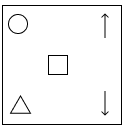
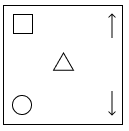
Correct — B. All five symbols survive from frame to frame; only their cells change.
Rule: every symbol moves one step along the loop centre → top-left → bottom-left → bottom-right → top-right → centre.
Check it on frames 1 and 2. The up-arrow at the centre goes to the top-left, the circle at the top-left goes to the bottom-left, the triangle at the bottom-left goes to the bottom-right, the square at the bottom-right goes to the top-right, and the down-arrow at the top-right comes into the centre.
Frame 4 holds square top-left, circle top-right, triangle centre, down-arrow bottom-left, up-arrow bottom-right. One more step gives triangle top-left, up-arrow top-right, circle centre, square bottom-left, down-arrow bottom-right — option (b).
Why the others are wrong
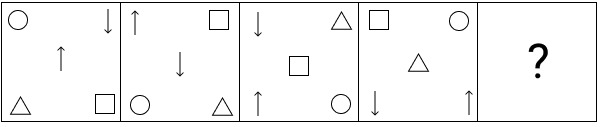
- (a)Option (a) puts the circle at the top-left, but that cell takes whatever stood at the centre of frame 4, which was the triangle. It also parks the square in the centre, a cell that only ever receives the previous frame's top-right symbol.
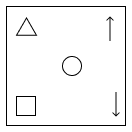
- (c)The square has not moved. It was top-left in frame 4 and must travel to the bottom-left, yet option (c) leaves it top-left. The two arrows are swapped as well.
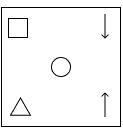
- (d)Square and triangle are both frozen in their frame-4 cells, top-left and centre, while the other three symbols shift. Every symbol moves one step in every frame, without exception.
Concept
This is a positional-rotation series. The frame keeps a fixed set of five symbols and five cells, and the only thing that changes between frames is which symbol sits where.
Because the set is fixed, you never have to ask what a symbol becomes — only where it goes. Pick one symbol, follow it across two consecutive frames, and you have the whole route.
Here the route visits the four corners anticlockwise and drops into the centre between the top-right and the top-left, giving a five-stop loop for five symbols.
The figures print small in the paper. Redraw the five cells as a rough plus sign on your sheet and write the symbols in, or you will be reading the arrows off a two-millimetre picture under time pressure.
Key facts
- The route is centre, top-left, bottom-left, bottom-right, top-right, back to centre.
- Five symbols on a five-stop loop means the sixth frame would repeat the first exactly.
- Two consecutive frames fix the rule, and the remaining frames only confirm it.
Study next
Common traps
- Reading the route as a plain walk of the four corners and forgetting the centre is a stop on it
- Checking two or three symbols against an option and marking before the other two are verified
- Reversing the direction of travel, which turns this into option (a) or (c)
SSC prints four frames and asks for the fifth. The movement rule is set in the first two frames and never changes partway through the series.
The same positional loop drives the letter version at Reasoning Q.17 of this shift, where A to E travel top-left, top-right, bottom-right, bottom-left, centre.
Related PYQs
No directly related past PYQ was found.