
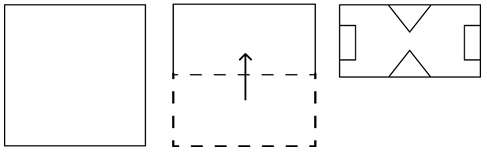
A square sheet of paper is folded along the dotted line successively along the directions shown and is then punched in the last. How would the paper look when unfolded?
- (a)
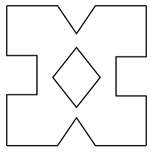
- (b)
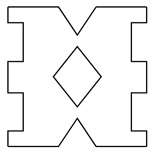
- (c)
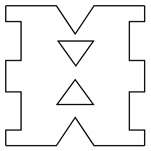
- (d)
Answer
Why
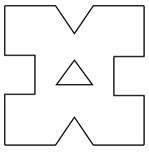
Correct — B. Rule: one fold, so every punch opens into two holes, mirrored about the crease.
The dashed lower half folds up, so the crease is the square's horizontal midline and the packet being punched is two layers thick.
Four cuts go in: a rectangular notch in each side edge, a triangular notch in the top edge, and a triangular notch in the bottom edge — which is the crease itself.
Unfolded, each side notch becomes two, one either side of the midline, and the top notch reappears in the bottom edge of the square.
The crease triangle meets its own mirror base to base, so the two open out as a single diamond at the centre. That is option (b).
Why the others are wrong
- (a)Option (a) gets the central diamond right but leaves a single notch in each side edge. The punch went through two layers, so each side notch must open into two, one above the crease and one below.
- (c)Option (c) doubles the side notches correctly but shows two separate triangles in the middle. The triangle cut on the crease has its base on the fold, so its mirror joins it base to base and the pair becomes one diamond.
- (d)Option (d) draws the folded packet's punches without unfolding them: a single triangle in the middle and a single notch in each side edge. One fold doubles every hole.
Concept
Paper folding is reflection bookkeeping. Count the folds first, because one fold doubles every punch and two folds quadruple them, and the count of holes alone often removes half the options.
Then locate the crease. The dashed part of the middle figure is the part that moves and the arrow shows where it goes, so the crease is the line the arrow crosses.
A punch sitting on the crease behaves differently from one sitting away from it. Away from the crease it opens into two separate holes. On the crease it opens into one hole of double the size, symmetric about the fold.
The triangular cut along the bottom of the punched packet sits on the crease, and that is the whole question. Its mirror does not appear beside it — it joins it, and two triangles become one diamond.
Key facts
- One fold doubles every punch, and two folds quadruple them.
- The dashed half of the middle figure is the half that moves.
- A punch away from the crease opens into two separate holes.
- A punch made on the crease opens into one symmetric hole of double the size.
Study next
Common traps
- Choosing the option that simply redraws the punched packet without unfolding it
- Reflecting the crease triangle away from the fold, which gives two triangles instead of one diamond
- Accepting side notches that straddle the crease rather than sitting either side of it
SSC shows the flat sheet, the fold with a dashed half and an arrow, and the punched packet, then asks for the unfolded sheet. The same frame appears at 18 Sep 2024, 09:00, Reasoning Q.4 and at 23 Sep 2024, 12:30, Reasoning Q.6.
Related PYQs
No directly related past PYQ was found.