
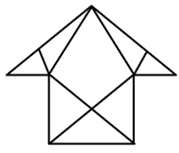
How many triangles are there in the given figure?
- (a)10
- (b)11
- (c)13
- (d)12
Answer
Why
Correct — B. The figure is an arrow: a square at the bottom, an apex above it, and a wing running out to each side along one horizontal line.
Rule: count region by region, and check that every edge is really drawn.
Left wing: two small triangles, plus the two of them together — 3. The right wing mirrors it — 3 more.
Square: both diagonals are drawn, but the top edge between the upper corners is missing, so the top small triangle and the two upper halves never close.
What survives is the left, right and bottom small triangles plus the two large halves cut off by a diagonal — 5.
3 + 3 + 5 = 11 → option (b).
Why the others are wrong
- (a)10 — 10 is what you get by missing one of the two large halves inside the square. Each diagonal cuts off a triangle spanning the full width, and the second is easy to skip once the small ones are counted.
- (c)13 — 13 counts the two upper halves of the square, and both of those need the top edge between the upper corners. That edge is not drawn, so those shapes are open and are not triangles.
- (d)12 — 12 is the count you reach by adding the top small triangle where the diagonals meet. Its base would be the missing top edge, so it never closes.
Concept
Triangle counting is reliable only when the counting is systematic, and the quickest system is by region.
Split the figure into parts that share no lines — here the two wings and the square — count each part, then look for triangles straddling a boundary. There are none here, because each wing meets the square at a single corner point.
The second discipline is checking that every side of a candidate triangle is really drawn.
In this figure the square's top edge is absent, and every over-count of it comes from assuming that edge is there.
The horizontal line runs from the far left tip to the square's top-left corner and then resumes at the top-right corner. That gap between the two upper corners is exactly what separates 11 from 13.
Each wing is cut in two by a short line dropping from its outer slant to the square's upper corner — that line is where the wing's two small triangles come from.
Key facts
- The figure splits into a left wing, a right wing and a square, sharing no lines with each other.
- Each wing carries three triangles: two small ones and the union of the two.
- The square has both diagonals but no top edge, which leaves five triangles inside it.
- A square with all four sides and both diagonals drawn would contain eight triangles.
Study next
Common traps
- Assuming the square's top edge exists because the horizontal line appears on both sides of it.
- Counting four small triangles inside a diagonal-crossed square without checking all four sides.
- Counting the same triangle twice while moving between regions.
SSC sets a plain 'how many triangles' item with a small line figure in Reasoning across CGL 2024 shifts — 9 Sep 2024, 09:00, Reasoning Q.19 is keyed at 21, and 9 Sep 2024, 12:30, Reasoning Q.1 is keyed at 4.
Here all four options sit within two of the true count, so an approximate count is worth nothing.
Related PYQs
No directly related past PYQ was found.