
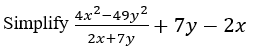
Simplify (4x² − 49y²) ⁄ (2x + 7y) + 7y − 2x
- (a)

- (b)

- (c)

- (d)

Answer
Why
Correct — A. The stem is printed as an image: Simplify (4x² − 49y²) ⁄ (2x + 7y) + 7y − 2x.
The numerator is a difference of two squares, since 4x² = (2x)² and 49y² = (7y)².
4x² − 49y² = (2x + 7y)(2x − 7y)
Cancel the factor 2x + 7y against the denominator:
(4x² − 49y²) ⁄ (2x + 7y) = 2x − 7y
Add what is left: (2x − 7y) + 7y − 2x = 0.
Option (a) is the choice printed as 0.
Why the others are wrong
- (b)Option (b) reads 4x. It comes from adding the last term instead of subtracting it: (2x − 7y) + 7y + 2x = 4x. The stem writes − 2x.
- (c)Option (c) reads 7y. It follows from cancelling the fraction down to just 2x and losing the − 7y half of the quotient, after which 2x + 7y − 2x leaves 7y.
- (d)Option (d) reads 4x − 14y, which is 2 × (2x − 7y) — the quotient counted twice. That happens when the trailing + 7y − 2x has both of its signs flipped before it is added.
Concept
One identity carries the whole item: a² − b² = (a + b)(a − b).
With a = 2x and b = 7y the numerator factorises as (2x + 7y)(2x − 7y), and the denominator is one of those two factors, so the fraction reduces to 2x − 7y in a single step.
What remains, 7y − 2x, is the exact negative of that quotient, so the two cancel and the expression is 0. Spotting the difference of squares is the method — dividing long-hand costs the minute SSC is measuring.
The cancellation assumes 2x + 7y is not zero, which the question takes for granted by writing the fraction at all.
The answer does not depend on x or y, and a constant result is itself a signal: substitute x = 1 and y = 1 and you get −45 ⁄ 9 + 7 − 2 = 0, which confirms the simplification in a few seconds.
Key facts
- a² − b² = (a + b)(a − b), so 4x² − 49y² = (2x + 7y)(2x − 7y).
- A fraction whose numerator factorises to include the denominator reduces to the remaining factor.
- Substituting x = 1 and y = 1 gives −45 ⁄ 9 + 7 − 2 = 0, a fast check on the simplification.
Study next
Common traps
- Cancelling term by term inside the fraction instead of factorising the numerator first.
- Writing the quotient as 2x + 7y, which is the factor that was cancelled away.
- Dropping the minus sign on − 2x when the quotient is added to the trailing terms.
Here the stem and all four choices are printed as images — the options read 0, 4x, 7y and 4x − 14y — so the method has to be recognised from the shape of the expression, with only the word Simplify as instruction.
Related PYQs
No directly related past PYQ was found.