
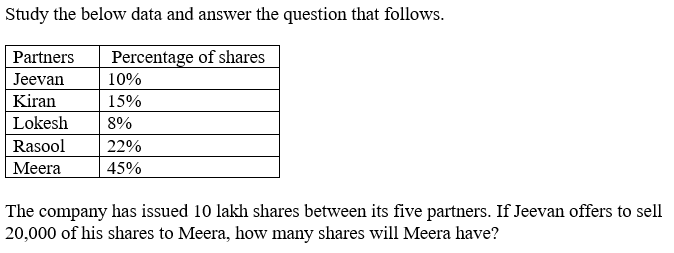
Study the below data and answer the question that follows. Partners → Percentage of shares Jeevan — 10% Kiran — 15% Lokesh — 8% Rasool — 22% Meera — 45% The company has issued 10 lakh shares between its five partners. If Jeevan offers to sell 20,000 of his shares to Meera, how many shares will Meera have?
- (a)4,60,000
- (b)4,80,000
- (c)4,70,000
- (d)5,10,000
Answer
Why
Correct — C. The stem is an image: a table of five partners with Jeevan 10%, Kiran 15%, Lokesh 8%, Rasool 22% and Meera 45% of 10 lakh issued shares.
Total issued = 10,00,000 shares
Meera's 45% = 0.45 × 10,00,000 = 4,50,000
She buys 20,000 more: 4,50,000 + 20,000 = 4,70,000 → option (c)
Jeevan can cover the sale — his 10% is 1,00,000 shares, so he is left with 80,000.
Why the others are wrong
- (a)4,60,000 — 4,60,000 is 46% of the ten lakh, which is Meera's 45% plus only 10,000 shares. The transfer is 20,000, a full 2 percentage points.
- (b)4,80,000 — 4,80,000 is 48%, a transfer of 30,000 shares. Jeevan sells 20,000, and nothing in the table alters Meera's starting 45%.
- (d)5,10,000 — 5,10,000 is 51%, sitting 60,000 shares above Meera's 4,50,000 — three times the 20,000 that actually changes hands.
Concept
A percentage table with one stated total is a two-step question: convert the shares to counts, then apply the transaction.
Here 45% of 10,00,000 is 4,50,000, and the sale moves whole shares, not percentages, so add 20,000 directly rather than trying to add a percentage to a percentage.
If you would rather stay in percentages, convert the transfer first: 20,000 shares is 2% of ten lakh, Meera goes from 45% to 47%, and 47% of 10,00,000 is 4,70,000.
The five entries in the table add to 100% (10 + 15 + 8 + 22 + 45), which is the quick check that no partner has been left out of the data before you start computing.
Key facts
- The table's five shares sum to 100%, so all ten lakh shares are allotted.
- 1% of 10,00,000 shares is 10,000 shares, which makes every entry in this table easy to convert.
- Meera holds 4,50,000 shares before the sale and 4,70,000 after it.
- Jeevan's 10% is 1,00,000 shares, so selling 20,000 leaves him with 80,000.
Study next
Common traps
- Reading 20,000 as a percentage figure rather than as a count of shares.
- Taking 10 lakh as 1,00,000, which scales every answer down by a factor of ten.
- Subtracting the 20,000 from Meera, when it is Jeevan who is selling.
SSC prints a percentage table as an image, states the total separately in the sentence below it, then asks for a count after one change. The same shape is at 26 Sep 2024, 09:00, Quant Q.22, where a percentage distribution of students is applied to totals of 16,000 and 18,000 for two different years.
Related PYQs
No directly related past PYQ was found.