
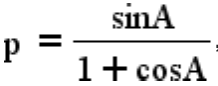
If , then is equal to:
- (a)

- (b)

- (c)

- (d)
Answer
Why
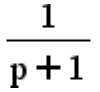
Correct — B. The stem is printed as images: p is defined as sinA ⁄ (1 + cosA), and the quantity wanted is sinA ⁄ (1 − cosA).
Multiply the two together and watch the denominator collapse:
p × sinA ⁄ (1 − cosA) = sin²A ⁄ [(1 + cosA)(1 − cosA)]
(1 + cosA)(1 − cosA) = 1 − cos²A = sin²A
so the product is 1
The second expression is therefore 1 ⁄ p, which is what option (b) shows. Check at A = 60°: p = (√3 ⁄ 2) ⁄ (3 ⁄ 2) = 1 ⁄ √3, and sinA ⁄ (1 − cosA) = (√3 ⁄ 2) ⁄ (1 ⁄ 2) = √3.
Why the others are wrong
- (a)Option (a) shows p − 1. At A = 60°, p ≈ 0.577, so p − 1 ≈ −0.42 — negative, while sinA ⁄ (1 − cosA) is positive for every A strictly between 0° and 180°.
- (c)Option (c) shows 1 ⁄ (1 − p). At A = 60° that is 1 ⁄ 0.42 ≈ 2.37, against the true √3 ≈ 1.73. Subtracting p from 1 has no identity standing behind it.
- (d)Option (d) shows 1 ⁄ (p + 1). At A = 60° it gives about 0.63, smaller than p itself, whereas the wanted value is p's reciprocal and so must exceed 1 whenever p is below 1.
Concept
The engine is 1 − cos²A = sin²A.
Rationalise sinA ⁄ (1 − cosA) by multiplying top and bottom by the conjugate (1 + cosA). The denominator becomes sin²A, one sinA cancels, and what is left is (1 + cosA) ⁄ sinA — exactly the reciprocal of p.
In half-angle language p = tan(A ⁄ 2) and sinA ⁄ (1 − cosA) = cot(A ⁄ 2), and those two are reciprocals by definition. Either reading reaches 1 ⁄ p, so use whichever you recall faster.
Because the expressions live in images, the row's plain text reads only as 'If , then is equal to:'. Nothing is missing from the paper — the algebra is in the pictures, and all four options are pictures too.
Key facts
- sinA ⁄ (1 + cosA) = (1 − cosA) ⁄ sinA = tan(A ⁄ 2).
- sinA ⁄ (1 − cosA) = (1 + cosA) ⁄ sinA = cot(A ⁄ 2).
- The product of those two expressions is 1 wherever both are defined, which is why one is the reciprocal of the other.
- Rationalising a trigonometric fraction means multiplying above and below by the conjugate of the denominator.
Study next
Common traps
- Cancelling sinA across the two fractions as though 1 + cosA and 1 − cosA were interchangeable.
- Multiplying by (1 − cosA) instead of the conjugate, which leaves (1 − cosA)² underneath and gets you nowhere.
- Answering with p, when the question asks for the expression that inverts it.
SSC names one expression with a letter and then asks for a partner expression that turns out to be its reciprocal or its conjugate. The same move is set at 25 Sep 2024, 16:00, Quant Q.14, where secθ + tanθ = x and sinθ is wanted.
Related PYQs
No directly related past PYQ was found.