
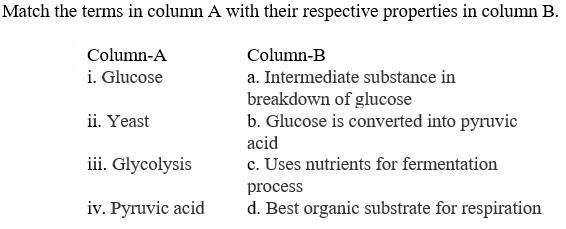
Match the terms in column A with their respective properties in column B. Column-A | Column-B i. Glucose | a. Intermediate substance in breakdown of glucose ii. Yeast | b. Glucose is converted into pyruvic acid iii. Glycolysis | c. Uses nutrients for fermentation process iv. Pyruvic acid | d. Best organic substrate for respiration
- (a)i-d, ii-c, iii-b, iv-a
- (b)i-b, ii-d, iii-a, iv-c
- (c)i-a, ii-b, iii-c, iv-d
- (d)i-b, ii-a, iii-d, iv-c
Answer
Why
Correct — A. Take the Column-A terms in order.
Glucose is the six-carbon sugar cells break down first, so it takes Column-B (d), the best organic substrate for respiration — i-d.
Yeast ferments sugar to ethanol and carbon dioxide without oxygen, so it takes (c), uses nutrients for the fermentation process — ii-c.
Glycolysis is the pathway that splits glucose into pyruvic acid, so it takes (b) — iii-b. That leaves pyruvic acid with (a), the intermediate in the breakdown of glucose — iv-a.
That sequence, i-d, ii-c, iii-b, iv-a, is option (a).
Why the others are wrong
- (b)i-b, ii-d, iii-a, iv-c — This pairs glucose with glucose is converted into pyruvic acid, which describes glycolysis rather than the sugar. The first link fails and the rest follows it.
- (c)i-a, ii-b, iii-c, iv-d — Here glucose is called an intermediate in its own breakdown. That reverses the relationship — glucose is the starting substrate and pyruvic acid is the intermediate.
- (d)i-b, ii-a, iii-d, iv-c — This makes yeast an intermediate substance in the breakdown of glucose. Yeast is an organism that carries out fermentation, not a metabolite.
Concept
Cellular respiration begins with glycolysis, which happens in the cytoplasm and needs no oxygen. One glucose molecule of six carbons is split into two molecules of pyruvic acid of three carbons each, with a small net gain of ATP.
What happens to pyruvate next depends on oxygen. With oxygen it enters the mitochondrion for the Krebs cycle. Without oxygen it is fermented — to lactic acid in our muscle, to ethanol and carbon dioxide in yeast.
That is why the columns line up as they do: glucose is the substrate, glycolysis the pathway, pyruvic acid the intermediate, yeast the organism.
The stem is printed as an image in the paper, so the columns are reproduced here.
Column-A: i. Glucose, ii. Yeast, iii. Glycolysis, iv. Pyruvic acid.
Column-B: a. Intermediate substance in breakdown of glucose, b. Glucose is converted into pyruvic acid, c. Uses nutrients for fermentation process, d. Best organic substrate for respiration.
Key facts
- Glycolysis takes place in the cytoplasm and does not require oxygen.
- One molecule of glucose yields two molecules of pyruvic acid in glycolysis.
- Yeast ferments pyruvate to ethanol and carbon dioxide.
- In human muscle under low oxygen, pyruvate is converted to lactic acid.
Study next
Common traps
- Matching yeast to a substance rather than to a process, because the other three entries in Column-A are chemicals or pathways
- Calling glucose the intermediate when the intermediate is pyruvic acid
A match-the-columns item gives you more to work with than a single-choice one, because one confident pair eliminates every option that contradicts it. Fix the pair you are sure of, then read the options for it.
Related PYQs
No directly related past PYQ was found.