
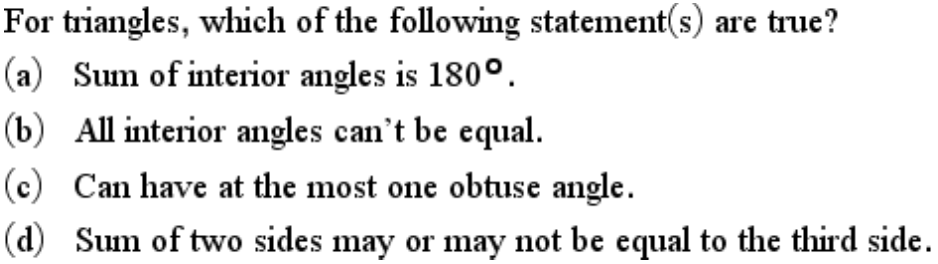
For triangles, which of the following statement(s) are true? (a) Sum of interior angles is 180°. (b) All interior angles can't be equal. (c) Can have at the most one obtuse angle. (d) Sum of two sides may or may not be equal to the third side.
- (a)(a) and (b)
- (b)(a), (b) and (d)
- (c)(a) and (c)
- (d)(b), (c) and (d)
Answer
Why
Correct — C. Test the four statements separately.
Statement (a): the interior angles of any triangle sum to 180° — true.
Statement (b): an equilateral triangle has all three angles equal at 60°, so all interior angles can be equal — false.
Statement (c): two obtuse angles would already pass 180°, so a triangle has at most one obtuse angle — true.
Statement (d): by the triangle inequality the sum of two sides is always greater than the third, never equal — false.
The true statements are (a) and (c) → option (c).
Why the others are wrong
- (a)(a) and (b) — This set keeps statement (b), which claims all interior angles cannot be equal. An equilateral triangle has three 60° angles, so statement (b) is false.
- (b)(a), (b) and (d) — This set carries both false statements. Statement (d) breaks the triangle inequality, under which the sum of any two sides is strictly greater than the third.
- (d)(b), (c) and (d) — This set drops the 180° angle sum, which is the one statement beyond dispute, and keeps (b) and (d), refuted by the equilateral triangle and by the triangle inequality.
Concept
Four separate claims about triangles, each standing or falling on its own.
The angle sum is 180°, which also forces at most one angle to be 90° or more. The equilateral triangle settles whether all three angles can be equal — they can, at 60° each.
The triangle inequality is strict: any two sides together exceed the third, and equality would flatten the figure into a straight line rather than a triangle.
The stem and its four statements are printed as an image on the response sheet. It reads: For triangles, which of the following statement(s) are true?
(a) Sum of interior angles is 180°. (b) All interior angles can't be equal. (c) Can have at the most one obtuse angle. (d) Sum of two sides may or may not be equal to the third side.
Key facts
- The interior angles of a triangle sum to 180°, so at most one of them can be 90° or more.
- An equilateral triangle has all three interior angles equal at 60°, which is what makes statement (b) false.
- The triangle inequality is strict, and equality of two sides with the third means the three points are collinear rather than a triangle.
- A triangle can hold at most one obtuse angle and at most one right angle.
Study next
Common traps
- Reading may or may not in statement (d) as a cautious hedge and therefore safe, when the inequality admits no equality case.
- Forgetting the equilateral triangle while judging whether all three angles can be equal.
- Supposing a triangle could carry two obtuse angles if the third angle were small enough.
SSC mixes true-or-false statement sets into its geometry questions, and the same facts surface directly elsewhere — the angle sum drives Quant Q.19 of the same 26 Sep 2024, 09:00 sitting, where a 7 : 8 : 3 ratio becomes 70°, 80° and 30°.
Related PYQs
No directly related past PYQ was found.