
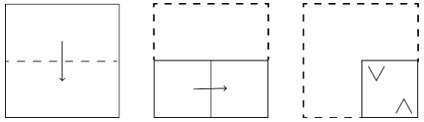
A paper is folded and cut as shown below. How will it appear when unfolded?
- (a)
- (b)
- (c)
- (d)
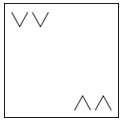
Answer
Why
Correct — C. Rule: two folds make four layers, so each cut is punched four times and the opened sheet must be a mirror image across both fold lines.
The first panel folds the top half down along the horizontal mid-line. The second folds the left half right along the vertical mid-line, so all the cutting is done on the bottom-right quarter.
That quarter carries a V near its top-left, which is the middle of the sheet, and a caret at its bottom-right, which is the sheet's own corner.
Open the vertical fold and those two marks reflect left-right into the bottom-left quarter, keeping their shape — a left-right mirror does nothing to a V or a caret.
Open the horizontal fold and the whole bottom half reflects upward, and that flip turns every V into a caret and every caret into a V.
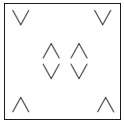
The sheet ends with eight marks: V at both top corners, caret at both bottom corners, and a central block of two carets above two Vs. That is option (c).
Why the others are wrong
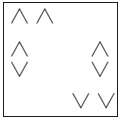
- (a)Eight marks, but not symmetric about either fold line: (a) stacks a caret pair at the top-left and a V pair at the bottom-right, leaving the other two corners bare. A fold reflects, and nothing can reflect into an empty corner.
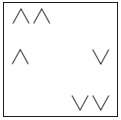
- (b)Only six marks. Two cuts through four layers must open into eight, so (b) is short before you check any position. Its top-right and bottom-left corners are empty as well.
- (d)Only four marks, a V pair at the top-left and a caret pair at the bottom-right. Four copies of two cuts is what a single fold would give, not two folds.
Concept
A paper-folding item is a reflection problem in disguise. Every fold doubles the layers, so two folds cut four copies of each shape and three folds cut eight.
The copies are not scattered. Each sits at the mirror position of the cut across a fold line, so you rebuild the sheet by undoing the last fold first, then the one before it.
Which mirror you are using decides what happens to the shape itself. A vertical fold line leaves a V looking like a V. A horizontal one turns it upside down.
Counting is the fastest first filter here. With two cuts and two folds the answer must carry eight marks, and that alone settles two of the four options before any position is checked.
Key facts
- Each fold doubles the number of layers, so two folds give four and every cut opens into four copies.
- A left-right mirror leaves V and caret unchanged, since both are symmetric about a vertical axis.
- A top-to-bottom mirror swaps V and caret.
- The unfolded sheet must be symmetric about every fold line that was used.
Study next
Common traps
- Undoing the folds in the order they were made instead of in reverse
- Forgetting that only the horizontal fold inverts a V into a caret
- Picking an option with the right shapes in the right corners but too few of them
SSC draws these in three panels — the sheet with a dashed fold line and an arrow, the folded state with the next fold marked, then the final quarter with the cuts drawn in.
Paper folding also runs at Reasoning Q.23 of this same 26 Sep 2024, 09:00 paper, and again 25 Sep 2024, 16:00, Reasoning Q.16 and 17 Sep 2024, 12:30, Reasoning Q.4.
Related PYQs
No directly related past PYQ was found.