
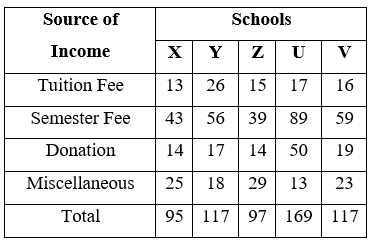
Annual income of five schools (in lakhs) In case of how many schools, the income by semester fee, is less than three times of donation?
- (a)4
- (b)2
- (c)3
- (d)5
Answer
Why
Correct — B. Test each school with the Semester Fee row against 3 × the Donation row.
X: donation 14, so the bar is 42. Semester fee 43. 43 > 42, fails.
Y: donation 17, so the bar is 51. Semester fee 56. 56 > 51, fails.
Z: donation 14, so the bar is 42. Semester fee 39. 39 < 42, qualifies.
U: donation 50, so the bar is 150. Semester fee 89. 89 < 150, qualifies.
V: donation 19, so the bar is 57. Semester fee 59. 59 > 57, fails.
Z and U qualify, so the count is 2 → option (b)
Why the others are wrong
- (a)4 — 4 needs two more schools to join Z and U, but each of the others clears its bar: X's 43 against 42, Y's 56 against 51 and V's 59 against 57.
- (c)3 — 3 is the count for the reversed inequality — semester fee greater than 3 × donation is true for X, Y and V. The stem asks for less than.
- (d)5 — 5 would mean every school qualifies. Only Z and U do, and X misses by a single lakh (43 against a bar of 42), which is the closest call in the table.
Concept
The table gives annual income in lakhs for five schools, X to V, split across four sources with a Total row.
A comparison question like this one is row-wise arithmetic, not estimation: take the Semester Fee entry, take the Donation entry, multiply the donation by 3 and compare.
Five comparisons, one multiplication each. The Total row is useful only as a check that you have read the column correctly — X's 13 + 43 + 14 + 25 comes to the 95 printed.
Two of the five comparisons are decided by a margin of one or two lakhs (X: 43 against 42, V: 59 against 57), so an eyeballed answer flips the count.
Key facts
- Semester Fee row, in lakhs: X 43, Y 56, Z 39, U 89, V 59.
- Donation row, in lakhs: X 14, Y 17, Z 14, U 50, V 19.
- Only Z (39 against a bar of 42) and U (89 against 150) have semester fee below 3 × donation.
- Each Total equals its four sources added — X: 13 + 43 + 14 + 25 = 95.
Study next
Common traps
- Comparing the semester fee with the donation itself instead of with 3 × the donation.
- Counting X because 43 and 42 look equal at a glance.
- Reading down the Total row instead of the Semester Fee row.
Counting questions on a table ask 'in how many cases', and the answer is a small number the options bracket tightly — so every row must actually be tested.
Table interpretation also appears at Quant Q.22 of the 26 Sep 2024, 9:00 am sitting, which gives a percentage distribution of students across four schools.
Related PYQs
No directly related past PYQ was found.