
Select the figure from among the given options that can replace the question mark (?) in the following series.

- (a)
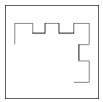
- (b)
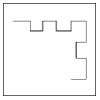
- (c)
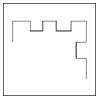
- (d)

Answer
Why
Correct — A. One outline is being rubbed out, a fixed number of segments at a time, always from the same open end.
Figure 1 is a closed castellated loop: two square notches cut into the top edge, two into the bottom edge, one into the left edge and one into the right edge.
Rule: each step erases the next three straight segments of the outline, working anticlockwise — down the left edge, then left to right along the bottom.
Figure 2 loses the left-edge notch, which is three segments (in, down, out), leaving a gap in the left edge.
Figure 3 loses the rest of the left edge, the bottom-left corner stretch and the step up after it.
Figure 4 loses the raised stretch that followed, the step down and the low stretch after that, so what survives at the bottom begins with a short upward tick.
Figure 5 must therefore lose that upward tick, the raised stretch and the step down — leaving only the short low line that runs into the bottom-right corner, with the top edge, the right edge and the stub below the top-left corner untouched.
That is option (a).
Why the others are wrong
- (b)Option (b) has also erased at the top-left: the short vertical hanging below the top-left corner is gone. Only one end of the broken outline retreats, and that stub is the fixed end.
- (c)Option (c) removes the bottom-right stretch as well — four segments instead of three — so the right edge ends in mid-air with no corner to turn at.
- (d)Option (d) still carries the short vertical tick at the left end of the bottom line, so only two segments have gone. The step is a fixed three each time.
Concept
In a decreasing figure series the useful question is not what is left but what is removed, and in what unit.
Separate the parts that never change from the part that shrinks, then measure the shrinkage in straight segments rather than in area or in notches.
Here the top edge, the right edge and the small stub below the top-left corner are constant from Figure 2 onward. Everything that changes happens along one continuous stretch of the outline, and it changes by the same amount each step.
That gives a test you can apply to every option in seconds: count the segments the option has removed relative to Figure 4. Only one option removes exactly three, and only one leaves the fixed parts alone.
Options (a) and (d) look almost identical at thumbnail size — they differ by a single short vertical tick at the left end of the remaining bottom line. Enlarge the images before choosing.
Key facts
- Identify the unchanging part of the figure before analysing the change.
- Measure the change in straight segments, not in how much ink remains.
- Three segments are erased at each step, always from the same open end.
- From Figure 2 onward the outline is an open arc with two ends, one fixed and one retreating anticlockwise.
Study next
Common traps
- Judging by how much of the outline is left rather than counting segments removed.
- Assuming both ends of the broken outline retreat, which is what option (b) shows.
- Choosing on a thumbnail, where the tick that separates options (a) and (d) is invisible.
The stem is the bare line 'Select the figure from among the given options that can replace the question mark (?) in the following series.' and every clue is in the picture.
The same stem carries a figural series at 12 Sep 2024, 16:00, Reasoning Q.13 and at 10 Sep 2024, 16:00, Reasoning Q.18.
Related PYQs
No directly related past PYQ was found.