
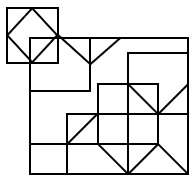
How many triangles are there in the given figure?
- (a)14
- (b)17
- (c)18
- (d)15
Answer
Why
Correct — B. Count block by block and add.
Top-left square and its diamond: 5. The diamond joins the four mid-points, cutting a triangle off each corner.
The big figure's corner sits at the centre of that square: its top edge runs through the diamond's right point, its left edge through the bottom point, and the diamond's lower-right side closes a fifth between them.
The V below and right of it: 3. Two slants meet on a vertical — one each side, plus the wide one together.
Right of centre: 3. A cell cut corner to corner gives two; a slant off the right border closes a third on the long horizontal.
Lower left of centre: 2. Another cell cut corner to corner.
Bottom strip: 4. Two slants meet on the base to make a downward triangle, the vertical through that point halves it, and a fourth stands on the bottom edge to its right.
5 + 3 + 3 + 2 + 4 = 17 — option (b).
Why the others are wrong
- (a)14 — 14 is three short. It is the tally you reach when the two compound triangles are missed and the fifth triangle in the top-left square goes unnoticed — its three sides come from two different parts of the drawing, so it is easy to skip.
- (c)18 — 18 counts a triangle that is not closed. Right of centre two slants start at the same level and meet on the long horizontal below, but the line joining their upper ends stops short of the right-hand border, so they enclose nothing between them.
- (d)15 — 15 is the count of the basic triangles alone. It leaves out the two larger ones, each made by joining a neighbouring pair: the wide V near the top and the downward triangle on the bottom strip.
Concept
Triangle counting is only reliable when it is systematic. Split the figure into blocks that do not share a slanting line, count each block, then add the blocks up.
Inside a block, count the smallest triangles first and only then look for the ones made by joining two or more of them.
Those compounds are what separate a careful count from a fast one. Here fifteen of the seventeen are basic shapes and a further pair are each made of two neighbours, which is why both 15 and 17 appear among the options.
Two slants that meet at a point close a third, larger triangle only when the line joining their far ends is drawn. That single test decides the V near the top, where the joining line is there, and the pair right of centre, where the horizontal stops short.
Key facts
- The figure holds 17 triangles: 15 basic shapes and 2 built from a neighbouring pair.
- A square with its four mid-points joined always cuts off four corner triangles.
- Two slants meeting at a point close a larger triangle only if the line joining their far ends is drawn.
Study next
Common traps
- Counting only the smallest triangles and stopping at 15
- Assuming a horizontal runs the full width of the figure when it in fact stops part-way
Triangle-counting is set with figures of very different density — also asked 9 Sep 2024, 16:00, Reasoning Q.8 (answer 8) and 11 Sep 2024, 09:00, Reasoning Q.3 (answer 11).
Related PYQs
No directly related past PYQ was found.