
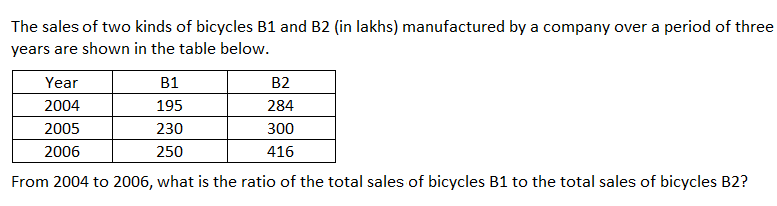
The sales of two kinds of bicycles B1 and B2 (in lakhs) manufactured by a company over a period of three years are shown in the table below. Year → B1 | B2 2004 — 195 | 284 2005 — 230 | 300 2006 — 250 | 416 From 2004 to 2006, what is the ratio of the total sales of bicycles B1 to the total sales of bicycles B2?
- (a)

- (b)

- (c)

- (d)

Answer
Why
Correct — B. The stem table gives B1 as 195, 230, 250 and B2 as 284, 300, 416 across 2004, 2005 and 2006. Total each column first, then reduce.
B1 total = 195 + 230 + 250 = 675
B2 total = 284 + 300 + 416 = 1000
Divide both by HCF(675, 1000) = 25:
675 : 1000 = 27 : 40 → option (b)
The wording asks for B1 to B2, so the smaller total, 675, is written first.
Why the others are wrong
- (a)9 : 10 is 0.9, but the totals give 675 ⁄ 1000 = 0.675. It survives only if the two terms are cancelled by different numbers — 675 by 75 and 1000 by 100 — which changes the ratio.
- (c)40 : 27 is the keyed ratio reversed. The stem asks for B1 to B2, and B1's total is the smaller of the two, so the first term must be the smaller one.
- (d)10 : 9 reverses an already-wrong ratio: it both overstates B1's share at 1.11 against the true 0.675 and puts the larger term first.
Concept
Two operations, in this order: total the columns, then reduce the ratio. Totalling first is what the phrase over a period of three years asks for.
B1 sums to 675 and B2 to 1000. Reducing needs the highest common factor of the pair, which is 25 — both end in a multiple of 25, and 675 = 27 × 25 while 1000 = 40 × 25.
Because every entry is in lakhs, the unit cancels in the ratio, so 27 : 40 needs no unit attached.
Ratios are direction-sensitive in a way that differences and sums are not. The ratio of B1 to B2 is 27 : 40 and the ratio of B2 to B1 is 40 : 27, and SSC has put both on the list.
An approximate check settles it in seconds: 675 is a little over two-thirds of 1000, and 27⁄40 = 0.675 while 40⁄27 ≈ 1.48.
Key facts
- B1's 2004–2006 sales total 195 + 230 + 250 = 675 lakh.
- B2's totals over the same years are 284 + 300 + 416 = 1000 lakh.
- HCF(675, 1000) = 25, so the ratio reduces to 27 : 40.
- The ratio of A to B always writes A's figure first, which is why 27 : 40 and 40 : 27 are different answers.
Study next
Common traps
- Cancelling the two terms by different factors and landing on 9 : 10.
- Writing the ratio in the order the table prints rather than the order the question asks.
- Averaging the three yearly ratios instead of taking the ratio of the totals.
SSC's table items reward totalling before dividing, and the reversed ratio sits on this option list. The same table skill returns at Quant Q.9 of this paper, at 25 Sep 2024, 09:00, Quant Q.5 and at 09 Sep 2024, 16:00, Quant Q.11.
Related PYQs
No directly related past PYQ was found.