
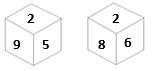
Two different positions of the same dice with faces 9, 2, 5, 3, 8 and 6 are shown below. Select the number that will be on the face opposite to the one having 2.
- (a)6
- (b)5
- (c)3
- (d)9
Answer
Why
Correct — C. Rule: any face you can see beside another face cannot be opposite it.
The picture gives two views of one cube. In the left-hand view the top face is 2, with 9 on the front-left and 5 on the front-right. In the right-hand view the top face is again 2, now with 8 on the front-left and 6 on the front-right.
So 2 is adjacent to 9, 5, 8 and 6.
The six faces are 9, 2, 5, 3, 8 and 6. Strike out 2 itself and its four neighbours, and one number is left: 3 — option (c).
Why the others are wrong
- (a)6 — 6 shares an edge with 2 in the right-hand view, where 2 is on top and 6 on the front-right. Adjacent faces are never opposite.
- (b)5 — 5 shares an edge with 2 in the left-hand view, sitting on the front-right while 2 is on top.
- (d)9 — 9 shares an edge with 2 in the left-hand view, on the front-left face. Of the six numbers, only 3 never appears beside 2.
Concept
A cube has three opposite pairs. Every face you can see at the same time as another is adjacent to it, so one view rules out two candidates and a second view rules out two more.
Here both views show 2 on top, which makes the elimination direct: collect the four faces seen beside 2, and the sixth number is its opposite.
When no face repeats between the two views you have to rotate the cube mentally instead, which is slower and where most errors start.
Both pictures show the same number on the top face, so no rotation is needed at all. That is the easy version of this stem, and it should take under twenty seconds.
Key facts
- A cube face is adjacent to four faces and opposite exactly one.
- Across the two views 2 appears beside 9, 5, 8 and 6, which leaves 3 as its opposite.
- Two views that share a visible face settle an opposite pair by elimination alone.
Study next
Common traps
- Treating the two pictures as different dice when the stem says both are the same one
- Reading only one view, which leaves two candidates standing rather than one
Two-position dice items recur with numbers or with letters on the faces — also asked 10 Sep 2024, 16:00, Reasoning Q.20 (faces 3, 7, 8, 2, 9 and 4) and 12 Sep 2024, 09:00, Reasoning Q.18 (faces T, O, B, L, Y and V).
Related PYQs
No directly related past PYQ was found.