
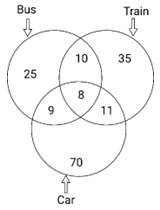
Study the given diagram carefully and answer the question that follows. The numbers in different sections indicate the number of persons travelling by different modes of transport. How many people travel by bus and car both, but NOT by train?
- (a)19
- (b)27
- (c)17
- (d)9
Answer
Why
Correct — D. Translate the words into a single region, then read it off the figure.
Bus and car both, but NOT by train, is the region where the Bus and Car circles overlap and the Train circle does not reach: 9.
The central region, 8, is excluded, because those people travel by train as well.
That leaves 9, which is option (d).
Why the others are wrong
- (a)19 — Option (a) adds a train region back in. 9 + 10 = 19 pulls the bus-and-train overlap into a count that the words NOT by train explicitly exclude.
- (b)27 — 27 is 10 + 9 + 8. Option (b) sums every region inside the Bus circle except bus-only, which sweeps train travellers in rather than removing them.
- (c)17 — 17 is 9 + 8. Option (c) adds the central all-three region to the bus-and-car region — and that central region is exactly the group NOT by train removes.
Concept
The phrase to isolate is NOT by train. It strips the central region out of what would otherwise be the whole Bus-Car overlap.
The Bus and Car circles meet in two regions: the crescent lying outside the Train circle (9) and the central region inside all three (8). "Both, but NOT by train" keeps the first and discards the second.
Had the question asked simply how many travel by bus and car, the answer would be 9 + 8 = 17 — which is why 17 sits in the option list.
NOT is printed in capitals in the stem, and the option list contains the value you get by ignoring it. Read the capitalised word before you read the diagram.
Key facts
- The figure prints Bus only as 25, Train only as 35 and Car only as 70.
- The pairwise-only regions are Bus-Train 10, Bus-Car 9 and Train-Car 11, with 8 in the centre.
- Bus and car but not train is the single region 9, while bus and car including train travellers would be 9 + 8 = 17.
Study next
Common traps
- Including the central 8 and answering 17, the value the option list is built to catch.
- Summing every region inside the Bus circle that is not bus-only, which gives 27.
- Assigning a number to the wrong circle because the labels sit outside the diagram on arrows.
19 Sep 2024, 16:00, Reasoning Q.18 asks the same shape of question — how many students like Hindi and Science both, but NOT Maths — on a subjects diagram. Reasoning Q.20 of this sitting uses the identical stem for a difference between two regions instead of an exclusion.
Related PYQs
No directly related past PYQ was found.