
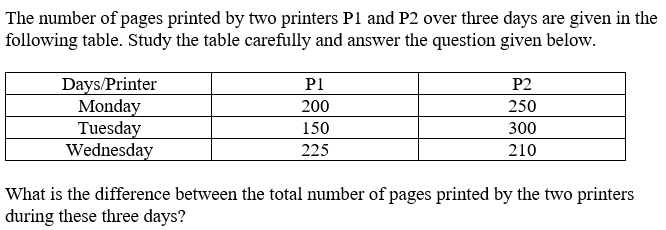
The number of pages printed by two printers P1 and P2 over three days are given in the following table. Study the table carefully and answer the question given below. Days/Printer → P1 | P2 Monday — 200 | 250 Tuesday — 150 | 300 Wednesday — 225 | 210 What is the difference between the total number of pages printed by the two printers during these three days?
- (a)185
- (b)180
- (c)170
- (d)175
Answer
Why
Correct — A. Read each printer's column down the table and add it.
P1: 200 + 150 + 225 = 575 pages
P2: 250 + 300 + 210 = 760 pages
Difference = 760 − 575 = 185 → option (a).
Day by day it comes to the same thing: P2 leads by 50 on Monday and by 150 on Tuesday, and trails by 15 on Wednesday, so 50 + 150 − 15 = 185.
Why the others are wrong
- (b)180 — 180 needs column totals of 580 and 760, or 575 and 755. The table gives 575 and 760, a gap of 185 — re-add Wednesday's 225.
- (c)170 — 170 is what you get by deducting Wednesday's 15-page gap twice: 50 + 150 − 15 − 15. Wednesday is deducted once, which leaves 185.
- (d)175 — 175 follows from a P2 total of 750. Added correctly, 250 + 300 + 210 = 760, so the gap is 185.
Concept
A two-column table like this asks for a difference of totals, and the difference of the totals equals the signed sum of the daily differences — computing both is the cheapest check you have.
Column sums: P1 = 575, P2 = 760.
The one feature worth noticing is that Wednesday reverses the lead: P1 prints 225 against P2's 210. Ignore that sign and you get 50 + 150 + 15 = 215 instead of 185.
The numbers are small enough to add in your head, so the mark here is lost to misreading a row, not to arithmetic. Keep a finger on the column you are adding.
Key facts
- P1 printed 200, 150 and 225 pages on Monday, Tuesday and Wednesday, totalling 575.
- P2 printed 250, 300 and 210 pages over the same three days, totalling 760.
- The difference of the two totals equals the signed sum of the daily gaps: 50 + 150 − 15 = 185.
- Wednesday is the one day in the table on which P1 prints more than P2.
Study next
Common traps
- Taking absolute daily differences, which gives 215 because Wednesday's 15 is added rather than subtracted.
- Adding a row instead of a column — the rows here are days, not printers.
- Answering with a total when the question asks for a difference.
SSC reuses the printers-and-days table shape with a different question on top: a ratio version is asked at 25 Sep 2024, 09:00, Quant Q.7 (three printers, three days). Table reading also appears at Quant Q.9 of this paper, on soft-drink bottles produced 2016-2020.
Related PYQs
No directly related past PYQ was found.