
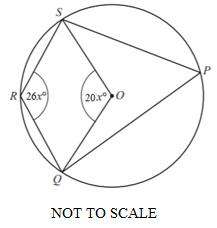
In the figure shown above, quadrilateral PQRS has its vertices on the circumference of the circle with centre O. If m ∠ QOS = 20x° and m ∠ QRS = 26x°, then what is the value of ‘x’?
- (a)4
- (b)3
- (c)6
- (d)5
Answer
Why
Correct — D. In the figure S, P, Q and R lie on the circle in that order and O is the centre. The 20x° marker is the angle QOS on the side of O facing R, and 26x° is the angle QRS at the vertex R.
∠QRS stands at the circumference on the arc QS that goes through P, so its central angle is the reflex one, 360° − 20x°.
Angle at centre = 2 × angle at circumference:
360 − 20x = 2 × 26x
360 = 52x + 20x = 72x
x = 5 → option (d).
Check: 20x = 100° and 26x = 130°, so ∠QPS = ½ × 100° = 50° and the opposite pair 50° + 130° = 180°, as a cyclic quadrilateral requires.
Why the others are wrong
- (a)4 — 4 is where you drift by treating 20x° as the vertex angle opposite R and writing 20x + 26x = 180. That gives x ≈ 3.9 and 4 is the nearest option, but 20x° is measured at the centre O, not at P.
- (b)3 — Substitute x = 3: ∠QOS = 60°, so the angle at the circumference on the far arc is ½ × 300° = 150°, while 26x would be only 78°. The two readings of the same arc disagree.
- (c)6 — Substitute x = 6: ∠QOS = 120°, so the circumference angle is ½ × 240° = 120°, but 26x is 156°. Only x = 5 makes the two agree.
Concept
Two circle facts do the work: the angle at the centre is twice the angle at the circumference on the same arc, and the opposite angles of a cyclic quadrilateral sum to 180°.
The trap is which arc. ∠QRS has its vertex at R, so it stands on the arc QS that does not contain R — the one through P. The central angle for that arc is the reflex angle at O, 360° − 20x°, not the marked 20x°.
Either route closes: use the reflex angle directly, or halve 20x° to get ∠QPS and pair it with ∠QRS against 180°. Both give 72x = 360.
The figure is marked NOT TO SCALE, so the drawn sizes carry no information — only the two labels and the order of the four points around the circle do.
Key facts
- An arc subtends at the centre twice the angle it subtends anywhere on the remaining circle.
- Opposite angles of a cyclic quadrilateral add to 180°.
- With x = 5 the figure reads ∠QOS = 100°, ∠QRS = 130° and ∠QPS = 50°.
Study next
Common traps
- Using the marked 20x° as the central angle for ∠QRS, which collapses to 26x = 10x.
- Adding the central angle to the vertex angle and setting the sum to 180°.
- Trusting the drawing after it has told you it is not to scale.
SSC sets the centre-versus-circumference rule plainly — 80° at the centre, find the circumference angles, at 24 Sep 2024, 12:30, Quant Q.24 — and inside an inscribed quadrilateral at 19 Sep 2024, 12:30, Quant Q.2. Here the two dressings are combined and both angles are given in terms of x.
Related PYQs
No directly related past PYQ was found.