
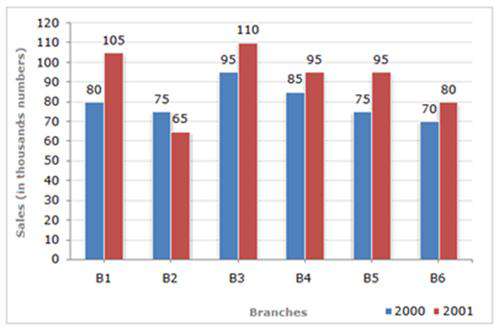
Study the given bar-graph and answer the question that follows. The bar-graph shows the sales of books (in thousands) from six branches (B1, B2, B3, B4, B5 and B6) of a publishing company during two consecutive years 2000 and 2001. What percentage of the average sales of branches B1, B2 and B3 in 2001 is the average sales of branches B1, B3 and B6 in 2000?
- (a)87.5%
- (b)80.25%
- (c)78.5%
- (d)65.25%
Answer
Why
Correct — A. The values are printed above the bars.
2000: B1 80, B2 75, B3 95, B4 85, B5 75, B6 70.
2001: B1 105, B2 65, B3 110, B4 95, B5 95, B6 80.
Average of B1, B2, B3 in 2001 = (105 + 65 + 110) ⁄ 3 = 280⁄3
Average of B1, B3, B6 in 2000 = (80 + 95 + 70) ⁄ 3 = 245⁄3
The stem asks what the 2000 average is as a percentage of the 2001 average, so the 2001 figure is the base and the ⁄3 cancels:
245 ⁄ 280 × 100 = 7⁄8 × 100 = 87.5% → option (a).
Why the others are wrong
- (b)80.25% — 80.25% of the base 280 is 224.7, but the 2000 bars are whole numbers and B1 + B3 + B6 is exactly 245. The two-decimal look is the bait — the true ratio 245⁄280 is the clean fraction 7⁄8.
- (c)78.5% — 78.5% is 87.5% with its first two digits swapped, the standard transcription slip on an answer this clean. The ratio to form is 245⁄280, and that is 87.5% exactly.
- (d)65.25% — 65.25% would need the 2000 trio to total about 183 against the 2001 trio's 280. The three smallest 2000 bars are 70, 75 and 75, so no reading of the graph gets that low.
Concept
'A is what percentage of B' puts B in the denominator. Here B is the 2001 average for B1, B2 and B3, and A is the 2000 average for B1, B3 and B6 — a different year and a different set of branches, which is the whole difficulty.
Both sides average three branches, so the ⁄3 cancels and you may work with the raw totals: 245 against 280.
The axis says 'in thousands', but a ratio of two quantities in the same unit is unit-free, so the thousands never enter the arithmetic.
Every bar carries its value as a printed label, so nothing here depends on measuring heights against the axis.
Key facts
- In 2000 the sales were B1 80, B2 75, B3 95, B4 85, B5 75 and B6 70 thousand.
- In 2001 the sales were B1 105, B2 65, B3 110, B4 95, B5 95 and B6 80 thousand.
- 245⁄280 reduces to 7⁄8, which is 87.5%.
Study next
Common traps
- Inverting the ratio and computing 280⁄245, which gives about 114%.
- Taking B1, B2 and B3 from the 2000 bars because they are named first in the sentence.
- Reading B2's 2001 bar as 75 to match its 2000 partner, when it is the one branch that fell, to 65.
The same six-branch books graph is set again with different questions on it — a branch-to-branch percentage at 10 Sep 2024, 12:30, Quant Q.21 and a ratio at 23 Sep 2024, 09:00, Quant Q.23. The picture is fixed and the wording moves, so read the wording.
Related PYQs
No directly related past PYQ was found.