
What is the value of
- (a)

- (b)

- (c)

- (d)

Answer
Why
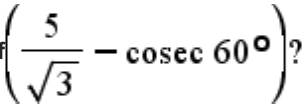
Correct — D. The stem image reads (5⁄√3 − cosec 60°), and the four option images read (a) 1⁄√3, (b) 2⁄√3, (c) 3√3 and (d) √3.
sin 60° = √3⁄2
cosec 60° = 1 ⁄ sin 60° = 2⁄√3
5⁄√3 − 2⁄√3 = 3⁄√3
3⁄√3 = 3√3 ⁄ (√3 × √3) = 3√3⁄3 = √3 → option (d).
Why the others are wrong
- (a)1⁄√3 is what you get by 'cancelling' the 3 on top of 3⁄√3 against the 3 inside the root. You cannot cancel across a radical sign — √3 × √3 = 3, so 3⁄√3 rationalises to √3.
- (b)2⁄√3 is cosec 60° itself — the quantity being subtracted, not the result. It is a correct first step marked as the final answer.
- (c)3√3 is the rationalisation left half-finished. Multiplying 3⁄√3 top and bottom by √3 gives 3√3⁄3, and the 3s must still cancel to leave √3.
Concept
Two things are tested at once: the standard value of cosec 60°, and the habit of rationalising a surd before matching an option.
cosec is the reciprocal of sin, so cosec 60° = 1 ÷ (√3⁄2) = 2⁄√3. Both terms then share the denominator √3 and the subtraction is just 5 − 2 = 3 on top.
The last move is where marks go: 3⁄√3 = √3, because multiplying top and bottom by √3 gives 3√3⁄3. A surd left in a denominator will not match any printed option.
The expression and all four options are printed as images on the response sheet, so this card names each option by the value it shows rather than by position.
Key facts
- sin 60° = √3⁄2, so cosec 60° = 2⁄√3.
- 3⁄√3 = √3, because multiplying top and bottom by √3 gives 3√3⁄3.
- cosec, sec and cot are the reciprocals of sin, cos and tan respectively.
Study next
Common traps
- Writing cosec 60° as √3⁄2, which is sin 60°.
- Leaving the answer as 3⁄√3 and hunting for that form among the options.
- Cancelling the numerator 3 against the 3 inside √3.
Elsewhere the reciprocal ratios sit inside a longer expression — an identity to simplify at 25 Sep 2024, 09:00, Quant Q.1 — while Quant Q.14 here turns sec θ + tan θ = x into sin θ. This item strips the dressing away and asks for a single subtraction.
Related PYQs
No directly related past PYQ was found.