
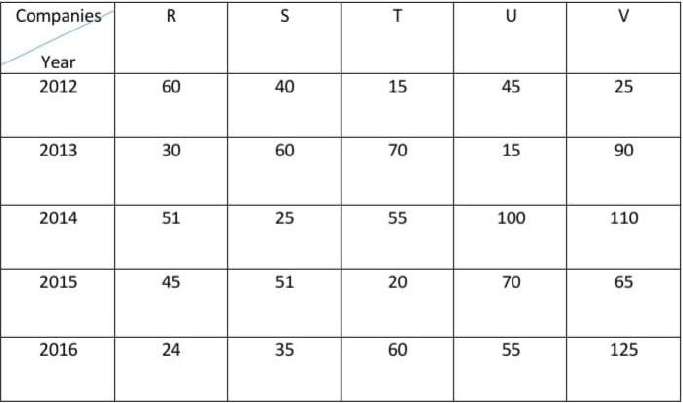
Consider the following table for total exports of goods of 5 companies over 5 years (in lakhs). If the ratio of exports to the imports of companies S and U in the year 2015 is 3 : 2 and 1 : 2, respectively, then, the total imports (in ₹ lakhs) of companies S and U together in the year 2015 is:
- (a)121
- (b)174
- (c)157
- (d)187
Answer
Why
Correct — B. Read the 2015 row first, then turn each ratio the right way round.
From the table, 2015 exports: S = 51, U = 70 (₹ lakhs)
S has exports : imports = 3 : 2, so imports = 51 × 2⁄3 = 34
U has exports : imports = 1 : 2, so imports = 70 × 2⁄1 = 140
Total imports = 34 + 140 = 174 → option (b)
Why the others are wrong
- (a)121 — 121 is 51 + 70, the exports of S and U added with neither ratio applied. The stem asks for imports, which the ratios still have to convert.
- (c)157 — 157 is 140 + 17, and 17 is 51 ÷ 3 — one step short. The ratio 3 : 2 makes S's imports two-thirds of its exports, not one-third.
- (d)187 — 187 would need S to import 47 or U to import 153, and neither ratio yields those. With 3 : 2 and 1 : 2 the two imports are pinned at 34 and 140.
Concept
A ratio question on a DI table has two independent halves: finding the right cell, then applying the ratio in the right direction.
exports : imports = 3 : 2 means imports = exports × 2⁄3. Whichever quantity you are solving for, its term goes on top.
For U the ratio is 1 : 2, so imports are double the exports. Same rule, opposite effect, and it is why U dominates the total.
The two ratios differ deliberately: one shrinks the figure and the other grows it, so applying a single direction to both lands you on a wrong option.
The table is printed as an image and the stem is split around it.
The 2015 row reads R 45, S 51, T 20, U 70, V 65 in ₹ lakhs, and only the S and U cells are used.
Key facts
- In 2015 the table gives exports of ₹51 lakh for company S and ₹70 lakh for company U.
- If exports : imports = 3 : 2, then imports = exports × 2⁄3.
- S imports ₹34 lakh and U imports ₹140 lakh, which total ₹174 lakh.
Study next
Common traps
- Adding the two export figures, 51 and 70, and answering 121
- Multiplying by 3⁄2 for S instead of 2⁄3, which inflates the import figure
- Picking the 2014 or 2016 row, since the years run 2012 to 2016 and 2015 is the fourth row down
SSC prints the table as an image with the stem split around it, so the ratio arrives only after the table. The same paper reads a table for a difference of column totals at 25 Sep 2024, 12:30, Quant Q.6, and for an average at Quant Q.25.
Related PYQs
No directly related past PYQ was found.