
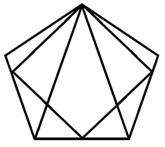
How many triangles are there in the given figure?
- (a)13
- (b)10
- (c)11
- (d)12
Answer
Why
Correct — A. Count in families, not at a glance.
Apex A, then B, C, D, E round the pentagon. M is the midpoint of the base where the two cuts meet, P and Q are where those cuts bend on the left and right sides, and X and Y are where PM crosses AD and QM crosses AC.
Left half, six: A-E-D, A-P-D, D-P-M, D-P-X, D-M-X, A-P-X.
Right half, six: the mirror set A-B-C, A-Q-C, C-Q-M, C-Q-Y, C-M-Y, A-Q-Y.
Across the middle, one: A-D-C, standing on the whole base.
6 + 6 + 1 = 13, which is option (a).
That 13 leaves out the two corner slivers A-E-P and A-B-Q. They are closed triangles too, and counting them takes the figure to 15 — see the note on the key below.
Why the others are wrong
- (b)10 — 10 falls three short of 13. Seven of those thirteen are composites — one triangle built from two or three of the smallest cells, as A-P-D is A-P-X plus P-X-D. Miss three of the seven and you land here.
- (c)11 — 11 is 13 less D-P-M and C-Q-M, the two triangles you see only when the pair of cells either side of a crossing is read as one shape.
- (d)12 — 12 misses A-D-C, the large triangle on the full base, which is easy to skip because both slanting cuts run straight across its interior.
Concept
Counting figures is bookkeeping, not an eye test. Label the vertices first, then sweep in layers: the smallest regions with no line running through them, then every triangle made of two of those, then of three.
Worked that way nothing is counted twice and nothing large is missed. The figure here is a pentagon carrying both diagonals from the apex, plus two more cuts that leave the apex, bend at a point on each slanting side, and run on to the midpoint of the base.
Counting items are where a tentative key and a careful hand count can part company, and this is such a case — see the note on the key. Take the method from this card rather than the number.
Key facts
- Six lines leave the apex: the two sides, both diagonals, and the two cuts that bend at P and Q on their way to the midpoint of the base.
- It is symmetric about the vertical line through the apex, so the left and right halves must yield the same count.
- A triangle still counts when other drawn lines cross its interior, which is what makes the composite shapes easy to miss.
Study next
Common traps
- Counting only the smallest regions and stopping there
- Missing the largest triangle, the one standing on the full base
- Letting the two halves disagree — under symmetry that always means one half was miscounted
How many triangles are there in the given figure? recurs with different drawings and very different counts — 11 at 11 Sep 2024, 09:00, Reasoning Q.3, 16 at 10 Sep 2024, 12:30, Reasoning Q.22 and 21 at 9 Sep 2024, 09:00, Reasoning Q.19.
Related PYQs
No directly related past PYQ was found.