
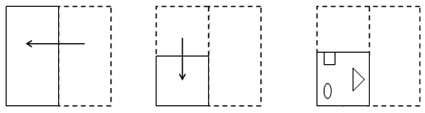
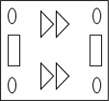
A paper is folded and cut as shown below. How will it appear when unfolded?
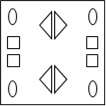
- (a)
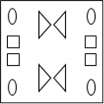
- (b)
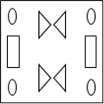
- (c)
- (d)
Answer
Why
Correct — C. Undo the folds in reverse order, and watch which cuts sit on a fold.
Right half onto left, then top onto bottom: the cut quarter is the bottom-left one, and its top and right edges are the fold lines.
Rule: a cut touching a fold opens across it; a cut clear of every fold repeats once per layer.
Square, hanging from the top edge → one tall rectangle across the horizontal fold, and its copy on the right.
Triangle, drawn near the right edge but clear of it → four copies, and since every unfold mirrors, each row holds a facing pair.
Oval, touching nothing → four copies.
That is option (c).
Why the others are wrong
- (a)Four separate small squares, and triangle pairs whose points face outward. The first fault ignores the fold the square hangs from; the second forgets that every unfold is a mirror.
- (b)Four separate small squares where the answer needs two tall rectangles — this is the picture you would get if the cut square hung clear of the horizontal fold instead of from it.
- (d)Rectangles and ovals are right, but the two triangles in each row point the same way. An unfold is a reflection, so the copy must face back at the original.
Concept
Paper-folding items are read backwards. Note the order of the folds, then undo the last one first; each undo reflects everything you have so far across that fold line.
How many copies a cut yields depends on where it sits. A cut clear of every fold appears once per layer, so two folds give four layers and four copies. A cut touching a fold has its own mirror joined to it along that line, so the two copies fuse into one larger shape and the total drops.
Only the small square is cut on a fold line here, which is why the answer mixes one shape appearing twice with two shapes appearing four times.
Key facts
- Two folds make four layers, so a cut clear of both fold lines opens into four copies.
- A cut sitting on a fold line opens into one shape symmetric about that line, not two separate shapes.
- Every unfold is a reflection, so a shape and its copy face each other across the fold.
Study next
Common traps
- Undoing the folds in the order they were made instead of in reverse
- Counting four copies of a cut that is sitting on a fold line
- Copying a shape across a fold without mirroring it
A paper is folded and cut as shown below is a fixed stem in the Reasoning block; 11 Sep 2024, 09:00, Reasoning Q.15 is another instance of it.
Related PYQs
No directly related past PYQ was found.