
The centres of two circles are 36 cm apart. If the radii of these two circles are 15 cm and 9 cm, respectively, then what is the sum of the lengths (in cm) of a direct common tangent and a transverse common tangent of these two circles?
- (a)
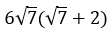
- (b)
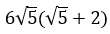
- (c)
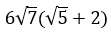
- (d)
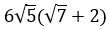
Answer
Why
Correct — D. Two standard lengths, then factor the sum into the form the options are printed in.
Direct common tangent = √(d² − (r₁ − r₂)²)
= √(36² − 6²) = √(1296 − 36) = √1260 = 6√35
Transverse common tangent = √(d² − (r₁ + r₂)²)
= √(36² − 24²) = √(1296 − 576) = √720 = 12√5
Sum = 6√35 + 12√5
√35 = √5 × √7, so 6√35 = 6√5 × √7 and 12√5 = 6√5 × 2
Sum = 6√5(√7 + 2), about 62.3 cm
That is option (d).
Why the others are wrong
- (a)Option (a), 6√7(√7 + 2), expands to 42 + 12√7. Its second term puts a 7 under the root of the transverse tangent, but √720 = 144 × 5 under the root, giving 12√5.
- (b)Option (b), 6√5(√5 + 2), has first term 6√5 × √5 = 30. That would make the direct tangent √900, not the √1260 that 36² − 6² actually gives.
- (c)Option (c), 6√7(√5 + 2), gets the direct tangent right at 6√35 but pairs it with 12√7. The transverse tangent squares to 1296 − 576 = 720, whose root is 12√5.
Concept
Both lengths come out of one right triangle. Slide the tangent parallel to itself onto the line of centres and you are left with a right triangle whose hypotenuse is d, the distance between the centres.
For a direct common tangent the remaining side is the difference of the radii, so the length is √(d² − (r₁ − r₂)²).
For a transverse common tangent the line crosses between the circles, so the remaining side is the sum of the radii: √(d² − (r₁ + r₂)²).
A transverse tangent exists only when d > r₁ + r₂. Here 36 > 24, so both tangents are real.
All four options are printed as 6√a(√b + 2) with a and b drawn from 5 and 7, so the arithmetic has to be carried all the way into factored form before the options can be told apart.
Key facts
- Direct common tangent = √(d² − (r₁ − r₂)²), here √(1296 − 36) = √1260 = 6√35.
- Transverse common tangent = √(d² − (r₁ + r₂)²), here √(1296 − 576) = √720 = 12√5.
- √35 = √5 × √7, so 6√35 + 12√5 factors as 6√5(√7 + 2).
- A transverse common tangent exists only when the centres are farther apart than the sum of the radii.
Study next
Common traps
- Swapping the formulas and using the sum of the radii for the direct tangent.
- Stopping at 6√35 + 12√5, a correct value that appears in none of the printed options.
- Glancing past option (a) and option (d) as though they were the same, when only the outer root differs.
This item asks for both tangents at once and then offers the four ways of pairing √5 and √7, so a right value in the wrong form still loses the mark. Direct common tangents are set at 9 Sep 2024, 09:00, Quant Q.17 and at 10 Sep 2024, 09:00, Quant Q.9, and the transverse tangent at 10 Sep 2024, 16:00, Quant Q.22.
Related PYQs
No directly related past PYQ was found.