
Select the figure from among the given options that can replace the question mark (?) and complete the pattern.

- (a)
- (b)
- (c)
- (d)
Answer
Why
Correct — B. The stem and all five panels are printed inside the picture, so read the four filled panels as a chain before opening the options.
Panel 1: star top-left, arrow centre, small square bottom-right.
Panel 2: small square top-right, star centre, S bottom-left.
Panel 3: S top-left, small square centre, M bottom-right.
Panel 4: M top-right, S centre, filled dot bottom-left.
Rule: the bottom-corner symbol climbs to the next panel's top corner, the top-corner symbol drops to the centre, the centre symbol leaves, and a fresh symbol enters at the bottom corner.
The corner pair also swaps diagonal every panel, so panel 5 goes back to top-left and bottom-right.
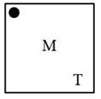
Panel 5 is therefore the dot at top-left, M at the centre, and a symbol not yet used at the bottom right — option (b), which puts T there.
Why the others are wrong
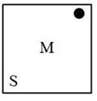
- (a)Option (a) keeps panel 4's top-right and bottom-left diagonal instead of swapping back, and it brings S in again when S is sitting in panel 4's centre, which is the position symbols leave from.
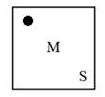
- (c)The diagonal and both carried symbols are right in option (c), but the arrival at the bottom right is S — already three panels into its run and departing from panel 4's centre, not entering.
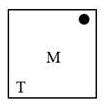
- (d)T is the right newcomer in option (d), but it sits at the bottom left with the dot at the top right, repeating panel 4's diagonal instead of alternating back.
Concept
This is a migration pattern, not a shape pattern. What matters is where each symbol sits and how long it stays, so the fastest route is to write the three positions of every panel in a row before comparing anything.
Two rules run at once. Symbols travel along a fixed path — bottom corner, then top corner, then centre, then out — which gives each symbol a life of exactly three panels.
And the corner pair alternates between the two diagonals, so an odd-numbered panel uses one diagonal and an even-numbered panel the other.
Every option puts M in the centre, so the centre decides nothing. The panel is settled by which diagonal the corners use and by which symbol is fresh, and each wrong option gets one of those two right.
Key facts
- The corner pair alternates diagonal from panel to panel — top-left and bottom-right in panels 1 and 3, top-right and bottom-left in panels 2 and 4.
- Each symbol appears in three consecutive panels — first at a bottom corner, then at a top corner, then at the centre.
- S enters at panel 2, reaches the top corner at panel 3 and sits in panel 4's centre, which is its last appearance.
- All four options print M in the centre, so the centre cannot separate them.
Study next
Common traps
- Choosing on the centre symbol, which every option gets right.
- Forgetting that the corner pair alternates diagonal from panel to panel.
- Letting S back in at panel 5 when panel 4 is the last of its three panels.
SSC prints this item's stem inside the picture, so the question text on the response sheet is blank and the panels have to be read off the image itself. The same complete-the-pattern frame is asked at 12 Sep 2024, 12:30, Reasoning Q.19 and at 13 Sep 2024, 12:30, Reasoning Q.13.
Related PYQs
No directly related past PYQ was found.