
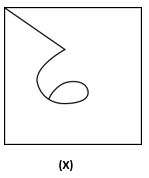
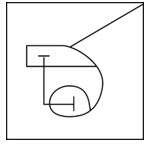
Select the option figure in which the given figure (X) is embedded (rotation is NOT allowed).
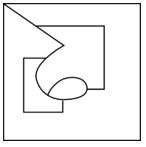
- (a)
- (b)
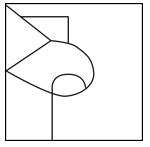
- (c)
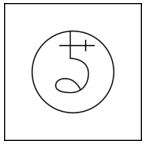
- (d)
Answer
Why
Correct — A. Figure (X) is one bent-and-curved stroke plus a small oval, so match it as a whole shape rather than piece by piece.
Rule: an embedded figure keeps every angle, length and orientation — the option may only add lines around it.
Trace (X) first. A straight line runs from the top-left corner down to the right and stops dead at a sharp V-point near the middle.
From that point the line doubles back to the left and curves down into a narrow hook.
The hook's tail runs into a small oval lying on its side, tilted up to the right.
Option (a) carries all three, unturned and in the same relative positions, with rectangle edges drawn around and behind them. Nothing has been stretched and nothing is missing.
Why the others are wrong
- (b)The straight run does not stop at the V-point in option (b) — it carries on to a second vertex on the left edge — and the narrow hook is redrawn as a broad teardrop that swells far to the right.
- (c)Option (c) has no straight diagonal at all. Where (X) runs a line into the V-point, this figure puts a small cross, and it wraps everything inside a large circle that (X) does not contain.
- (d)The diagonal in option (d) descends from the top-right corner, which is (X)'s stroke flipped left to right, and the item allows no turning or flipping of (X).
Concept
An embedded-figure item asks whether a given outline survives inside a busier drawing untouched. The test is rigid: same lengths, same angles, same orientation. Extra lines may cross it and hide it, but not one of its own lines may move.
The efficient method is to pick the most distinctive feature of (X) and hunt for that alone. Here it is the sharp V-point where a straight line reverses into a curve, because a curve meeting a straight line at a fixed angle is hard to reproduce by accident.
Only when that feature is found do you check the rest.
The question says rotation is NOT allowed, so an option that shows (X) turned or mirrored is wrong even if every measurement matches. That rider is what makes option (d) a wrong answer rather than a second right one.
Key facts
- Figure (X) is a single continuous stroke — straight diagonal, sharp V-point, then a narrow downward hook — together with one small tilted oval that the hook's tail meets.
- The straight portion of (X) starts at the top-left corner of its frame and descends to the right.
- The question bars rotation, so a turned or mirrored copy of (X) does not count as embedded.
Study next
Common traps
- Matching on the oval alone, which more than one option contains.
- Accepting a mirrored copy because every length looks right, when the item forbids turning (X).
SSC prints (X) inside its own frame and puts the rider about rotation in the stem, so a flipped copy is a planted wrong answer rather than an oversight. The same embedded-figure frame is asked at 09 Sep 2024, 16:00, Reasoning Q.6 and at 11 Sep 2024, 12:30, Reasoning Q.18.
Related PYQs
No directly related past PYQ was found.