
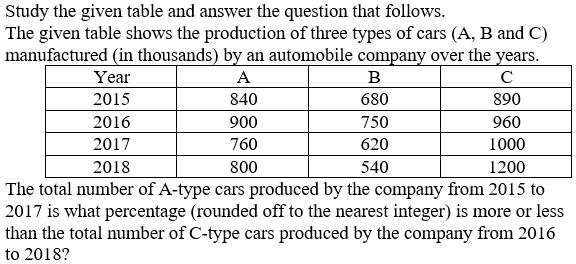
Study the given table and answer the question that follows. The given table shows the production of three types of cars (A, B and C) manufactured (in thousands) by an automobile company over the years. Year → A | B | C 2015 — 840 | 680 | 890 2016 — 900 | 750 | 960 2017 — 760 | 620 | 1000 2018 — 800 | 540 | 1200 The total number of A-type cars produced by the company from 2015 to 2017 is what percentage (rounded off to the nearest integer) is more or less than the total number of C-type cars produced by the company from 2016 to 2018?
- (a)More, 21%
- (b)More, 24%
- (c)Less,24%
- (d)Less, 21%
Answer
Why
Correct — D. The stem asks for two different three-year windows, so add exactly the cells it names.
A-type, 2015 to 2017: 840 + 900 + 760 = 2,500
C-type, 2016 to 2018: 960 + 1,000 + 1,200 = 3,160
A's total is the smaller, so the direction word is Less.
Difference = 3,160 − 2,500 = 660
Percentage = 660⁄3,160 × 100 = 20.886…%
Rounded to the nearest integer that is 21%
Less, 21% is option (d).
Why the others are wrong
- (a)More, 21% — Option (a), More, 21%, has the number right and the direction wrong. A's 2,500 sits below C's 3,160, so the comparison can only be a shortfall.
- (b)More, 24% — Option (b), More, 24%, is wrong twice over. The direction is Less, and the two totals the stem names give 660⁄3,160 = 20.886%, which rounds to 21.
- (c)Less,24% — Option (c), printed Less,24%, gets the direction right and the size wrong. 660 ÷ 3,160 = 0.2089, and a genuine 24% would need the gap to be about 758.
Concept
In the phrasing x is what percentage more or less than y, the quantity after *than* is the base. Here that is the C-type total, so 3,160 goes on the bottom.
The calculation is (y − x) ÷ y × 100 when x is the smaller, and the direction word simply records which of the two is bigger.
Both halves of the option — the word and the number — have to be right, so the base is worth one deliberate second before the arithmetic starts.
The two windows deliberately do not match: A is read across 2015 to 2017 and C across 2016 to 2018. The 2015 row and the 2018 row each belong to only one of the two sums.
Key facts
- A-type production for 2015, 2016 and 2017 is 840 + 900 + 760 = 2,500 thousand.
- C-type production for 2016, 2017 and 2018 is 960 + 1,000 + 1,200 = 3,160 thousand.
- In 'x is what per cent more or less than y', the base is y — here the C total of 3,160.
- 660 as a share of 3,160 is 20.886%, which rounds to 21%.
Study next
Common traps
- Dividing the 660 gap by 2,500 instead of 3,160, which returns 26.4% and matches no option.
- Reading both totals across the same three years and missing that the windows are offset.
- Choosing the right number with the wrong word, since More, 21% is on offer beside Less, 21%.
SSC pairs a direction word with a number inside each option, so the mark rides on which quantity is the base as much as on the arithmetic. A production table is read the same way at 23 Sep 2024, 09:00, Quant Q.22, and table reading also carries Quant Q.5 and Q.7 of this shift.
Related PYQs
No directly related past PYQ was found.