
Find the values of 'a' and 'b' for which the system of equations 3x+y=3 and (a-b)x+ (a+b)y=3a+b-3 has infinite solutions.
- (a)
- (b)
- (c)
- (d)
Answer
Why
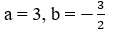
Correct — D. Infinite solutions means the two equations describe the same line, so all three coefficient ratios must agree.
For a₁x + b₁y = c₁ and a₂x + b₂y = c₂: a₁⁄a₂ = b₁⁄b₂ = c₁⁄c₂
Here: 3⁄(a − b) = 1⁄(a + b) = 3⁄(3a + b − 3)
First two: 3(a + b) = a − b → 2a = −4b → a = −2b
First and third: 3a + b − 3 = 3(a + b) → b − 3 = 3b → b = −3⁄2
Then a = −2 × (−3⁄2) = 3
Check: a − b = 4.5, a + b = 1.5 and 3a + b − 3 = 4.5, so all three ratios are 2⁄3.
a = 3 with b = −3⁄2 is option (d).
Why the others are wrong
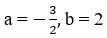
- (a)Option (a) shows a = −3⁄2, b = 2 — the two values swapped. Then a − b = −3.5 while a + b = 0.5, so 3⁄(a − b) is negative and 1⁄(a + b) = 2. The ratios do not even share a sign.
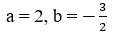
- (b)Option (b) shows a = 2 with the correct b = −3⁄2. Then a − b = 3.5 and a + b = 0.5, giving 3⁄3.5 = 6⁄7 against 1⁄0.5 = 2 — the x and y ratios disagree.
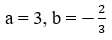
- (c)Option (c) shows a = 3 with b = −2⁄3, the fraction turned over. Then 3⁄(a − b) = 3 ⁄ (11⁄3) = 9⁄11 while 1⁄(a + b) = 3⁄7, so the first equality already fails.
Concept
A pair of linear equations in two unknowns falls into exactly three cases, decided by the coefficient ratios.
a₁⁄a₂ ≠ b₁⁄b₂ — one solution, the lines cross.
a₁⁄a₂ = b₁⁄b₂ ≠ c₁⁄c₂ — no solution, the lines are parallel.
a₁⁄a₂ = b₁⁄b₂ = c₁⁄c₂ — infinitely many, the lines coincide.
Infinite solutions is the strictest case: it demands both equalities. That is why two unknowns can be pinned down here — the ratio condition is really two equations in a and b.
Put the second equation into the form a₂x + b₂y = c₂ before taking any ratio. The constant term is 3a + b − 3, which carries the unknowns as well — treat it as c₂, not as something to be simplified away.
Key facts
- Infinite solutions require a₁⁄a₂ = b₁⁄b₂ = c₁⁄c₂, all three ratios equal.
- Equal first two ratios with a different third ratio means no solution, not infinitely many.
- For a = 3 and b = −3⁄2 the common ratio here is 2⁄3.
- The pair that satisfies both conditions is a = 3 and b = −3⁄2.
Study next
Common traps
- Using only a₁⁄a₂ = b₁⁄b₂ and stopping, which cannot separate parallel from coincident
- Reading 3a + b − 3 as belonging to the left-hand side rather than as the constant
- Finding a = −2b from the first pair and then guessing which option fits, instead of using the third ratio
The unknowns are hidden inside the coefficients, so the ratio condition becomes a small simultaneous system in a and b.
The same condition is asked at 12 Sep 2024, 12:30, Quant Q.25, and at 12 Sep 2024, 16:00, Quant Q.4, where the answer wanted is a + b rather than the pair.
Related PYQs
No directly related past PYQ was found.