
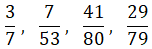
Which of the following fractions is the largest?
- (a)

- (b)

- (c)

- (d)

Answer
Why
Correct — C. The stem prints four fractions as an image — 3⁄7, 7⁄53, 41⁄80 and 29⁄79 — and the four options are those same fractions, one per picture.
Do not divide. Test each against 1⁄2 by doubling the numerator and comparing with the denominator.
3⁄7: 3 × 2 = 6, less than 7, so 3⁄7 < 1⁄2
7⁄53: 7 × 2 = 14, far below 53
29⁄79: 29 × 2 = 58, still below 79
41⁄80: 41 × 2 = 82, above 80
Only 41⁄80 clears one-half, so it is the largest. Option (c) is the picture showing 41⁄80.
In decimals: 41⁄80 = 0.5125, 3⁄7 = 0.4286, 29⁄79 = 0.3671, 7⁄53 = 0.1321.
Why the others are wrong
- (a)The picture in option (a) is 7⁄53, about 0.132. The numerator is not even a fifth of the denominator, making it the smallest of the four.
- (b)Option (b) shows 29⁄79, about 0.367. Doubling 29 gives 58, still well under 79, so it sits below one-half and below 41⁄80.
- (d)Option (d) shows 3⁄7, about 0.429 — the nearest rival, and the one a smallest-denominator rule of thumb picks. But 3 × 2 = 6 is under 7, so it stays below one-half.
Concept
Comparing four fractions pairwise takes six cross-multiplications. Comparing them all to one benchmark takes four.
The test for 1⁄2 is the cheapest there is: a fraction exceeds 1⁄2 exactly when twice the numerator exceeds the denominator.
Run it here and 41⁄80 lands above the line while 3⁄7, 7⁄53 and 29⁄79 land below, which settles the question in one pass.
When more than one candidate clears the benchmark, you fall back to cross-multiplying only those, not all four.
Denominator size decides nothing on its own. 29⁄79 and 41⁄80 have almost the same denominator and are nowhere near each other in value.
The numerator relative to the denominator is the only thing that matters.
Key facts
- A fraction a⁄b exceeds 1⁄2 exactly when 2a > b.
- 41⁄80 = 0.5125, the one value here above one-half.
- 3⁄7 = 0.4286 is the closest of the rest.
- Cross-multiplication compares two fractions: a⁄b > c⁄d exactly when ad > bc for positive b and d.
Study next
Common traps
- Assuming the smallest denominator gives the largest fraction, which points at 3⁄7
- Judging by the gap between numerator and denominator, where 3⁄7 has the smallest gap and still loses
- Starting long division on all four when one comparison with 1⁄2 settles it
SSC puts the four candidates in the stem image and repeats them as the option images, so the options carry no new information — the work is entirely the comparison.
The same stem is asked 18 Sep 2024, 12:30, Quant Q.10, again with the fractions as pictures.
Related PYQs
No directly related past PYQ was found.