
Select the figure from among the given option that can replace the question mark (?) in the following series.
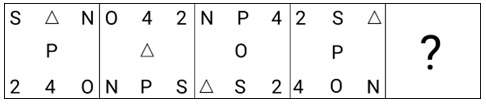
- (a)
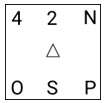
- (b)
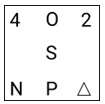
- (c)
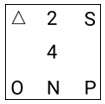
- (d)
Answer
Why
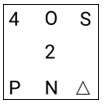
Correct — D. Every box carries the same seven marks — S, triangle, N, P, 2, 4, O — in a 3x3 frame whose middle-left and middle-right cells stay empty. Nothing is added or removed, so only the places move.
Two different moves alternate, and figure 5 is made by the move that made figure 3.
Rule: top-middle, top-right, bottom-right and bottom-middle turn a quarter clockwise, while top-left goes to the centre, the centre to bottom-left and bottom-left to top-left.
Figure 4 reads 2 S triangle across the top, P in the centre, 4 O N across the bottom.
The quarter turn sends S to top-right, triangle to bottom-right, N to bottom-middle, O to top-middle.
The three-cell slide sends 2 to the centre, P to bottom-left, 4 to top-left.
That builds 4 O S across the top, 2 in the centre, P N triangle across the bottom — option (d).
Why the others are wrong
- (a)The centre can only be fed by figure 4's top-left mark, which is 2. Option (a) parks the triangle there and keeps S and P in the bottom row, two cells the quarter turn empties.
- (b)S stands at figure 4's top-middle, so the quarter turn has to carry it to top-right. Option (b) drops S into the centre, a cell nothing but the top-left mark can reach.
- (c)Top-left is fed by figure 4's bottom-left mark, 4. Option (c) opens the row with the triangle and sends 4 to the centre instead, which runs the three-cell slide backwards.
Concept
A figure series like this one changes no shapes at all. The same seven marks reappear in every box, so the question is purely about position.
Read each box as a 3x3 frame with the middle row's outer cells left blank, giving seven live cells. Then write down where one mark travels from box to box rather than redrawing the grid.
The travel is not the same at every step here. Figure 1 to figure 2 and figure 3 to figure 4 share one move, figure 2 to figure 3 uses another. Once the alternation is visible, the fifth box needs only the second move applied to figure 4.
The other move, the one that made figures 2 and 4, is worth learning too: the four corners swap across the diagonals while the middle column slides down one place and wraps.
In the exam, tracking a single mark is enough. Figure 4's centre mark P must land at bottom-left, and that alone separates the four pictures.
Key facts
- The same seven marks — S, triangle, N, P, 2, 4 and O — appear in every box of the series.
- The frame is a 3x3 grid whose middle-left and middle-right cells are always empty, leaving seven live positions.
- Figure 4 reads 2 S triangle across the top, P in the centre and 4 O N across the bottom.
- The keyed figure reads 4 O S across the top, 2 in the centre and P N triangle across the bottom.
Study next
Common traps
- Assuming one rule runs the whole series and forcing figure 5 to repeat the figure 1 to figure 2 move
- Treating the empty middle-left and middle-right cells as part of the pattern
- Matching an option on its top row alone and never checking the centre
SSC sets this as a row of five boxes with the last one blank. Because the marks never change, only their positions can carry the pattern, so follow one mark's journey rather than redrawing every grid. Figure series also run at 25 Sep 2024, 16:00, Reasoning Q.14 and Q.19.
Related PYQs
No directly related past PYQ was found.