
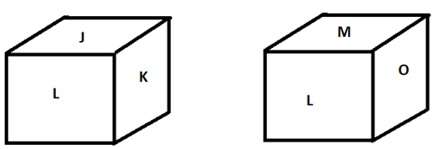
Six letters J, K, L, M, N and O are written on different faces of a dice. Two positions of this dice are shown in the figure below. Find the letter on the face opposite to N.
- (a)J
- (b)L
- (c)M
- (d)K
Answer
Why
Correct — B. One face is shown in both views, and that shared face is what makes the dice solvable.
The first view shows J on top, L in front and K on the right.
The second view shows M on top, L in front and O on the right.
Rule: a face that shares a view with another face touches it, so the two cannot be opposite.
L is the front face in both views, so J, K, M and O all touch L. That is four of the five remaining letters, which leaves only N for the face opposite L.
If N faces L, then L faces N — option (b).
Why the others are wrong
- (a)J — J is on top while L is in front in the first view, so J touches L. The four letters that touch L are the same four that ring N, and a face that rings N cannot also face it.
- (c)M — M is on top in the second view with L again in front, which makes M a neighbour of L. Neighbours of L surround N rather than sitting across from it.
- (d)K — K is on the right with L in front in the first view, so K touches L and therefore sits beside N, not opposite it.
Concept
A cube face has four neighbours and exactly one opposite face. That single sentence solves most dice items, because every view you are given lists neighbours.
When two views share a face, the shortcut is complete. Collect every letter that appears alongside the shared face, and the letter that never appears alongside it is the opposite one.
Here four of the five other letters appear beside L across the two views, so the fifth is settled without any mental rotation at all.
Both views show the same three positions — top, front and right — with L in front each time, so the second view is the first turned a half-turn about the front face. That also pairs J with M and K with O, though the question asks for only one pair.
Key facts
- A cube face has four neighbours and exactly one opposite face.
- L is the front face in both views, so the four letters shown beside it — J, K, M and O — are all adjacent to L.
- With J, K, M and O all adjacent to L, the one remaining letter, N, must be the face opposite L.
Study next
Common traps
- Treating the two views as two different dice rather than one dice turned.
- Answering with a letter that shares a view with L, when sharing a view is proof of adjacency.
SSC sets the two-view dice with one face repeated, which is what lets all four neighbours be listed at once. The same two-view frame is asked at 09 Sep 2024, 09:00, Reasoning Q.3 and at 10 Sep 2024, 09:00, Reasoning Q.12.
Related PYQs
No directly related past PYQ was found.