
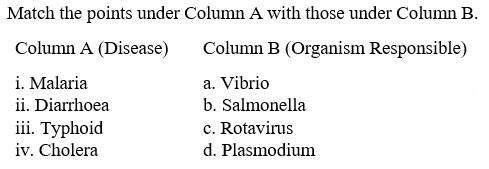
Match the points under Column A with those under Column B. Column A (Disease) | Column B (Organism Responsible) i. Malaria | a. Vibrio ii. Diarrhoea | b. Salmonella iii. Typhoid | c. Rotavirus iv. Cholera | d. Plasmodium
- (a)i-a, ii-c, iii-b, iv-d
- (b)i-a, ii-b, iii-c, iv-d
- (c)i-d, ii-c, iii-b, iv-a
- (d)i-b, ii-a, iii-c, iv-d
Answer
Why
Correct — C. The question is printed as an image: Column A holds four diseases, Column B four organisms.
Malaria (i) is caused by the protozoan Plasmodium, carried by the female Anopheles mosquito — so i-d.
Diarrhoea (ii) goes to Rotavirus, the commonest viral cause of severe diarrhoea in small children — ii-c.
Typhoid (iii) is caused by the bacterium Salmonella Typhi — iii-b. Cholera (iv) is caused by Vibrio cholerae — iv-a.
That reading is i-d, ii-c, iii-b, iv-a, which is option (c).
Why the others are wrong
- (a)i-a, ii-c, iii-b, iv-d — It opens i-a, handing malaria to Vibrio. Vibrio cholerae is a comma-shaped bacterium of contaminated water, while malaria is protozoal, so the string fails at its first pair.
- (b)i-a, ii-b, iii-c, iv-d — It is the columns read straight down, i-a, ii-b, iii-c, iv-d. That gives cholera to Plasmodium, a blood parasite that has nothing to do with cholera.
- (d)i-b, ii-a, iii-c, iv-d — It gives malaria to Salmonella, the typhoid bacterium, and typhoid to a virus. Two pairs cross the boundary between bacterial and non-bacterial disease.
Concept
Disease-to-organism matching is decided by organism group before any single name is recalled.
Three groups cover nearly everything SSC asks. Protozoa cause malaria, kala-azar and amoebiasis. Bacteria cause typhoid, cholera and tuberculosis. Viruses cause dengue, influenza, measles and rotaviral diarrhoea.
Sort the four diseases into groups first. Most wrong strings then die on sight, because they cross a group boundary — a protozoan handed a bacterial disease, or the reverse.
Diarrhoea is the loose pair here, since it has bacterial, viral and protozoal causes. The paper's own column forces the viral one, because the two bacteria in Column B are already spoken for by typhoid and cholera.
Key facts
- Malaria is caused by Plasmodium, a protozoan transmitted by the female Anopheles mosquito.
- Typhoid is caused by the bacterium Salmonella Typhi and spreads through contaminated food and water.
- Cholera is caused by Vibrio cholerae, a comma-shaped bacterium, and kills mainly through dehydration.
- Rotavirus is a leading cause of severe diarrhoea in infants and young children.
Study next
Common traps
- Reading the two columns straight down and answering i-a, ii-b, iii-c, iv-d without testing a single pair.
- Treating cholera and typhoid as interchangeable because both are bacterial and water-borne, when the organisms are Vibrio and Salmonella.
- Calling malaria bacterial, which rules out the correct string at the very first pair.
The same biology arrives in plain single-answer form too: 17 Sep 2024, 09:00, GA Q.15 asks which set of diseases is bacterial, and 18 Sep 2024, 16:00, GA Q.16 asks which bacterium is spiral-shaped.
Learn the organism attached to each disease and both formats fall out of one list.
Related PYQs
No directly related past PYQ was found.