
Simplify (1 + sin θ − cos θ) ⁄ (1 + sin θ + cos θ).
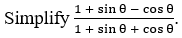
- (a)

- (b)

- (c)

- (d)

Answer
Why
Correct — A. Pair the 1 with the cosine, not with the sine, and the half-angle identities do the rest. Write t = θ⁄2.
1 − cos θ = 2 sin²t · 1 + cos θ = 2 cos²t · sin θ = 2 sin t cos t
Numerator = (1 − cos θ) + sin θ = 2 sin²t + 2 sin t cos t = 2 sin t (sin t + cos t)
Denominator = (1 + cos θ) + sin θ = 2 cos²t + 2 sin t cos t = 2 cos t (sin t + cos t)
The 2 and the bracket (sin t + cos t) are common to both, so they cancel.
What is left is sin t ⁄ cos t = tan(θ⁄2) → option (a).
Why the others are wrong
- (b)Option (b) is cos(θ⁄2), which never exceeds 1. As θ approaches 180°, cos θ → −1 and the given fraction runs to 2 ⁄ 0, growing without bound, so no cosine can equal it.
- (c)Option (c) is cot(θ⁄2), the reciprocal — what you get by cancelling and then reading cos t over sin t. At θ = 60° the expression is 1.366 ⁄ 2.366 = 0.577, while cot 30° = 1.732.
- (d)Option (d) is sin(θ⁄2), which is also capped at 1 and is too small in the middle of the range: at θ = 60° the expression is 0.577 but sin 30° = 0.5.
Concept
Every term here has a half-angle form. The three identities that matter are 1 − cos θ = 2 sin²(θ⁄2), 1 + cos θ = 2 cos²(θ⁄2) and sin θ = 2 sin(θ⁄2) cos(θ⁄2).
The move that makes them usable is the regrouping: read the numerator as (1 − cos θ) + sin θ and the denominator as (1 + cos θ) + sin θ. Pair the 1 with the sine instead and nothing factors.
After the substitution both lines carry the factor (sin t + cos t), which cancels. That is why the answer is a clean single function rather than an expression — a good sign you have grouped correctly.
The stem and all four options are printed as images in this response sheet: option (a) is tan(θ⁄2), (b) is cos(θ⁄2), (c) is cot(θ⁄2) and (d) is sin(θ⁄2). Testing at θ = 90° cannot separate (a) from (c), because tan 45° and cot 45° are both 1 — use θ = 60° instead.
Key facts
- 1 − cos θ = 2 sin²(θ⁄2), the identity that turns the numerator into a sine factor.
- 1 + cos θ = 2 cos²(θ⁄2), the matching identity for the denominator.
- sin θ = 2 sin(θ⁄2) cos(θ⁄2), which supplies the shared bracket that cancels.
- At θ = 60° the whole expression equals 0.577, which is tan 30°.
Study next
Common traps
- Grouping the 1 with sin θ, after which neither line factors.
- Cancelling correctly but inverting the last ratio, which lands on cot(θ⁄2).
- Checking the answer only at θ = 90°, where tangent and cotangent of the half-angle are both 1.
SSC sets these as reduce-to-a-single-value items — 25 Sep 2024, 09:00, Quant Q.1 asks for the value of (cosec θ − sin θ)(sec θ − cos θ)(tan θ + cot θ), which collapses the same way once each bracket is put over a common denominator.
Related PYQs
No directly related past PYQ was found.