
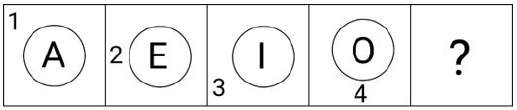
Select the figure from among the given options that can replace the question mark (?) in the following series.
- (a)

- (b)

- (c)

- (d)

Answer
Why
Correct — D. Two things change from box to box, so track them apart.
Rule 1: the letter inside the circle runs through the vowels in order — A, E, I, O — so the fifth box takes U.
Rule 2: the small digit counts 1, 2, 3, 4 and moves one place anticlockwise round the edge of the box each time: top-left, then middle-left, then bottom-left, then bottom-centre.
The next place on that walk is the bottom-right corner, which is where the 5 belongs → option (d).
Why the others are wrong
- (a)Places the 5 at middle-right. On this walk that is the stop after the bottom-right corner, so it is where a 6 would stand, not a 5.
- (b)Places the 5 at the top right, the far end of the walk. From bottom-centre the mark moves one place along the bottom edge, not up the opposite side.
- (c)Places the 5 back at middle-left, the position the 2 already used. The mark has since passed the bottom-left corner and does not return.
Concept
When a picture series changes two things at once, separate them and give each its own rule.
The letter follows a list you already know — the vowels — and its job is to tell you which term of the series you are on.
The digit carries the position rule. It steps one place anticlockwise around the border of the box for each new box, so where it lands is fixed by where it stood in box 4, not by where it started in box 1.
All four options print a U inside the circle and a 5 beside it, so neither the letter nor the number decides anything. The whole question turns on where the 5 is placed.
Key facts
- The vowels in order are A, E, I, O, U, so the fifth term takes U.
- The digit stands at top-left in box 1, middle-left in box 2, bottom-left in box 3 and bottom-centre in box 4.
- Continuing one place anticlockwise, the fifth position is the bottom-right corner.
Study next
Common traps
- Solving the letter, feeling finished, and picking the first option showing U
- Reading the walk as clockwise because its first three stops are all on the left edge
SSC prints the position marker small and off to one side, so it reads as decoration until you notice it has moved. Reasoning Q.18 of this paper runs the same picture-series frame with the change carried by the characters instead of by a position.
Related PYQs
No directly related past PYQ was found.