
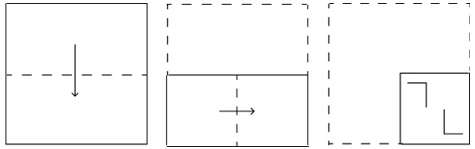
A paper is folded and cut as shown below. How will it appear when unfolded?
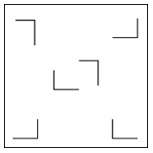
- (a)
- (b)
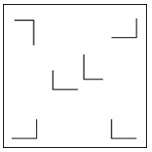
- (c)
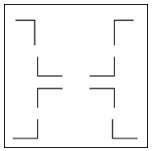
- (d)
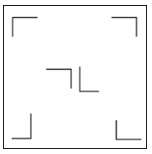
Answer
Why
Correct — C. Read the folds before the cuts.
Panel 1 folds the top half down. Panel 2 folds the left half to the right. What survives is the bottom-right quarter, and panel 3 draws two corner-shaped cuts inside it: one near the middle of the sheet, one near the outer corner.
Rule: each fold doubles a cut on unfolding, and every copy is a mirror image across the crease.
Two folds mean four layers, so each of the two cuts appears four times — eight marks in all.
Option (c) is the sheet with eight: four gathered round the centre, where the creases meet, and four out at the corners, mirrored about both fold lines → option (c).
Why the others are wrong
- (a)Six marks, not eight. The four corner cuts are there, but the centre carries two where four layers demand four.
- (b)Six marks again, and its two central cuts face the same way. A crease reflects, so the pair either side of the vertical fold must open in opposite directions.
- (d)Six marks, and its top row does not mirror its bottom row: the top-left cut opens right-and-down while the bottom-left one opens up-and-left, which no reflection in the horizontal crease produces.
Concept
Fold-and-cut is a counting question before it is a picture question.
Count the folds: n folds put 2 to the power n layers under the scissors, so a single cut shows up that many times on the opened sheet. One fold, two copies. Two folds, four.
Then place them. Each copy is the mirror of its neighbour across the crease they were folded on, so the opened sheet is symmetric about every fold line. A cut made close to a crease reappears close to that same crease on the other side of it.
The cuts here are drawn as thin corner marks rather than as holes with material removed, so nothing but position and orientation separates the options. Count first, then check the mirroring.
Key facts
- Two folds give four layers, so every cut appears four times on the opened sheet.
- The opened sheet is symmetric about each line it was folded along.
- A cut near a crease reappears near that same crease on the other side.
- In this item the folded piece is the bottom-right quarter: top folded down, then left folded right.
Study next
Common traps
- Counting the marks inside the folded quarter and looking for that same number in the options
- Getting the count right but taking an option whose two halves are not mirror images
SSC prints the folds as arrowed panels and puts the cuts only in the last one, so the fold order has to be read off the arrows before anything else. The same instruction runs at 10 Sep 2024, 09:00, Reasoning Q.23 and at 11 Sep 2024, 09:00, Reasoning Q.15.
Related PYQs
No directly related past PYQ was found.