
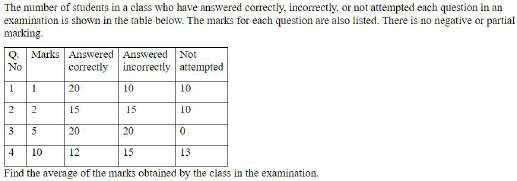
The number of students in a class who have answered correctly, incorrectly, or not attempted each question in an examination is shown in the table below. The marks for each question are also listed. There is no negative or partial marking. Q. No — Marks | Answered correctly | Answered incorrectly | Not attempted 1 — 1 | 20 | 10 | 10 2 — 2 | 15 | 15 | 10 3 — 5 | 20 | 20 | 0 4 — 10 | 12 | 15 | 13 Find the average of the marks obtained by the class in the examination.
- (a)5.75
- (b)5.25
- (c)6.75
- (d)6.25
Answer
Why
Correct — C. Only the correct column scores, because the stem rules out negative and partial marking.
Marks earned, row by row:
Q.1: 1 × 20 = 20
Q.2: 2 × 15 = 30
Q.3: 5 × 20 = 100
Q.4: 10 × 12 = 120
Total marks = 20 + 30 + 100 + 120 = 270
Class size, from any row: 20 + 10 + 10 = 40 students
Average = 270 ⁄ 40 = 6.75 → option (c).
Why the others are wrong
- (a)5.75 — 5.75 across 40 students is 230 marks. The four rows of the table give 270, so 5.75 leaves 40 marks of the class's score unexplained.
- (b)5.25 — 5.25 across 40 students is 210 marks, sixty short of the 270 the table yields. No single row is worth 60, so this is not one dropped line either.
- (d)6.25 — 6.25 across 40 students is 250 marks — exactly 270 less the 20 from Q.1. Skipping the one-mark row as negligible lands precisely here.
Concept
A marks table like this is a weighted total, not an average of averages. Multiply each question's mark value by the number of students who got it right, add the four products, and divide by the number of students.
The 'answered incorrectly' and 'not attempted' columns earn nothing, because the stem says there is no negative or partial marking. Their job is to let you read off the class size.
Every row of the table sums to 40, so the class is 40 students. Checking that the rows agree is worth the two seconds before you divide.
The stem is an image in the response sheet: a table with columns Q. No, Marks, Answered correctly, Answered incorrectly and Not attempted, four rows worth 1, 2, 5 and 10 marks, then the instruction to find the average of the marks obtained by the class.
Key facts
- Marks by row: 1 × 20 = 20, 2 × 15 = 30, 5 × 20 = 100 and 10 × 12 = 120.
- The class scores 270 marks in total.
- Each row of the table adds to 40 students, so the average is 270 ⁄ 40 = 6.75.
Study next
Common traps
- Dividing by 4, the number of questions, rather than by 40, the number of students.
- Scoring the incorrect or unattempted columns when the stem has ruled them out.
- Averaging the mark values 1, 2, 5 and 10 instead of weighting them by the correct counts.
The same weighted-average idea is set without a table when two groups arrive with their own averages. A 30-student class split 12 and 18 is asked at Quant Q.18 of this paper, and a batsman's twenty and twenty-five matches at 19 Sep 2024, 12:30, Quant Q.17.
Related PYQs
No directly related past PYQ was found.